

🎁 How to apply the TRX Training Discount Code

TRX is a suspension trainer: two adjustable straps with handles and foot cradles, hanging from a single anchor point above your head. You put your hands or your feet in the straps, keep the other end of your body on the floor, and your own bodyweight becomes the resistance. The name stands for Total-body Resistance Exercise. It was invented in 1997 by Randy Hetrick, a U.S. Navy SEAL who stitched the first prototype from a jiu-jitsu belt and parachute webbing while deployed overseas. What makes it different from weights is how you load it. Instead of adding plates, you change the angle of your body against the anchor. Walk your feet toward the anchor and every exercise gets harder. Walk them back and it gets easier. That single adjustment is why the same tool works for a deconditioned beginner and a professional athlete.
That’s the short answer. The rest of this page is the long one — the physics behind that angle, where the tool came from, the seven movement patterns it’s built around, what it does badly, and a first workout you can run today.
What is a suspension trainer?
A suspension trainer is deliberately simple. Two straps. One anchor. A pair of handles that double as foot cradles. Nothing else.
Compare that to a machine in a gym. A machine fixes the path of the movement, supports your spine, and isolates one muscle. It decides how you move. A suspension trainer decides nothing — it just hangs there and lets you fall in a controlled way.
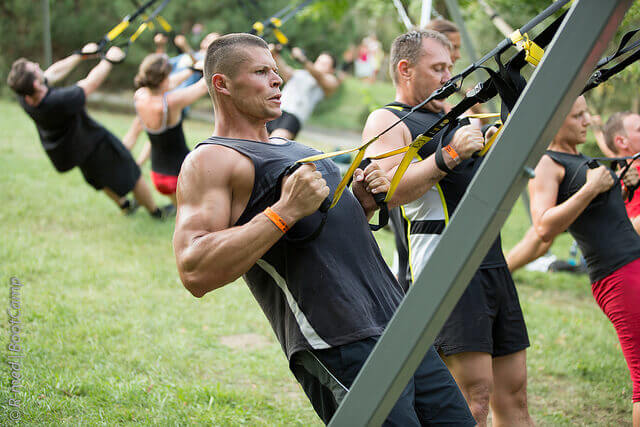
Both straps run from one anchor, which is why the tool itself is unstable — and why your trunk works on every rep.
That’s the whole trade. You give up stability and you get it back as work. Because both straps hang from one point, the equipment can’t hold you steady. Your body has to.
Two terms worth knowing before you go further:
- Anchor point. The fixed thing the straps hang from — a door, a ceiling mount, a beam, a branch, a squat rack. It needs to hold far more than you weigh.
- Strap length. How far you let the straps down. Every exercise has a setting, and the yellow embroidered marks on the straps let you find the same one twice.
The trainer packs into a bag the size of a lunch box, so the same kit hangs in a spare room, a hotel room, a garage or a park. That portability is the practical reason people buy one. The physics below is the reason they keep using it.
How does TRX Training work?
Here’s the part most articles skip. On a suspension trainer you never add weight — so where does the resistance come from?
From geometry. You always weigh the same, but how much of your weight your muscles have to control depends on the angle of your body. TRX built its method on three ways of changing that.
1. The Vector Resistance Principle — change your body angle
This is the main dial, and it’s the one you’ll use every session.
Stand facing the anchor holding the handles and lean back a few degrees. That’s a light row. Now walk your feet forward, toward the anchor, until your body is close to horizontal. Same exercise, same bodyweight, far more load.
| Your body angle | How it feels | Who it’s for |
|---|---|---|
| Almost upright | Light — you’re barely leaning into the straps | First session, rehab, warm-up sets |
| Around 45 degrees | Moderate — most people’s working range | General training |
| Close to horizontal | Hard — your feet carry almost nothing | Strong, well-practiced trainees |
💡 Scale with your feet before you scale with reps. Moving two steps changes the exercise more than adding five repetitions ever will.
2. The Pendulum Principle — move your start position
The straps hang straight down when nothing pulls on them. That’s neutral. Start an exercise with your body offset in front of neutral and gravity helps you through part of the range. Start behind it and gravity fights you the whole way.
It’s a smaller dial than body angle, but it’s why the same exercise can feel completely different depending on where you set your feet before the first rep.
3. The Stability Principle — change your base of support
Narrow your stance. Stand on one leg. Move your center of mass away from your feet. None of that changes how much you weigh, but all of it makes your trunk, hips and shoulders work harder to keep you where you want to be.
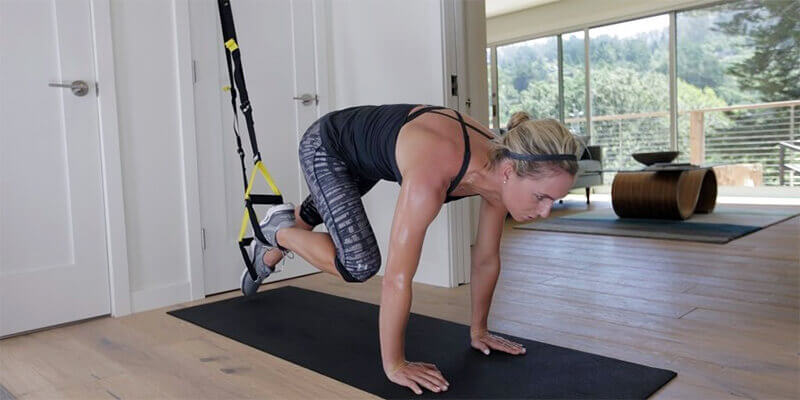
One step forward or back with the feet is the whole progression system — no plates, no pin, no waiting for a machine.
- When you stand upright, your legs carry essentially all of your bodyweight and the straps carry almost none.
- As you lean, part of your weight transfers into the straps. The more horizontal you get, the larger that share becomes — and the larger the share your working muscles have to move.
- Leaning also lengthens the lever between your feet and your center of mass. A longer lever means more torque at every joint in between, which is why a small step feels like a big jump.
- Because both straps hang from one point, the tool can’t stabilize you. The deep trunk musculature — transversus abdominis, the obliques, multifidus and the erector spinae — has to brace to stop your spine and pelvis from moving while your arms or legs do the exercise.
Why it works: a chest press stops being a chest exercise. It becomes a chest exercise performed inside a moving plank. That’s the whole method in one sentence, and it’s why a suspension session covers so much ground in so little time.
One more consequence worth stating plainly: both hands or both feet are joined to the same anchor. Push harder with one side and the strap on that side moves. You can’t hide a weak side the way you can on a barbell, which makes the tool honest about imbalances.
Where does TRX come from?
Not from a lab, and not from the U.S. military as a whole — from one person with a problem.
In 1997, Randy Hetrick was a U.S. Navy SEAL squadron commander deployed overseas with no gym, no weights and a team that still needed to stay strong. He took a jiu-jitsu belt he’d packed by accident and some webbing from a parachute harness, stitched them together, hung the result from a door and started training against his own bodyweight.

The design brief has never changed: a full-body training system that fits in a bag and hangs from whatever is available.
His teammates wanted their own. He kept refining it through the rest of his service, then went to Stanford’s business school, and in the early 2000s turned the prototype into a product. The company he founded was originally called Fitness Anywhere; today it trades as TRX Training.
Two things follow from that origin story, and both still shape the tool:
- It was built for people with no equipment. Everything about it — the weight, the pack size, the single anchor — comes from being designed in a place with none of the usual gear.
- It was built to be scaled by the user, not the equipment. A squadron has strong people and tired people training side by side. One tool had to serve both.
Suspension training as an idea is older than TRX — gymnasts have hung from rings for well over a century. What Hetrick did was turn it into an adjustable, portable system with a teaching method attached.
The seven foundational movements
TRX organizes its method around movement patterns, not muscle groups. The principle behind it: your body understands movements, not muscles. You never contract a single muscle in daily life — you push, pull, hinge, squat, step, rotate and brace.
Seven patterns cover all of it, and every exercise on a suspension trainer belongs to one of them.
| # | Pattern | Example exercise | Why you need it outside the gym |
|---|---|---|---|
| 1 | Plank | Standing Body Saw | Holding your spine steady while your limbs do the work |
| 2 | Pull | TRX Single Arm Row | Dragging, lifting toward you, opening a heavy door |
| 3 | Push | TRX Chest Press | Getting up off the floor, putting a case in an overhead bin |
| 4 | Hinge | TRX Single Leg RDL | Bending to pick something up without loading your lower back |
| 5 | Squat | TRX Squat | Sitting down and standing up, walking, running |
| 6 | Lunge | TRX Assisted Lunge | Stairs, changing direction, single-leg strength |
| 7 | Rotation | TRX Power Pull | The most common movement of all — golf, tennis, lifting a child onto your hip |
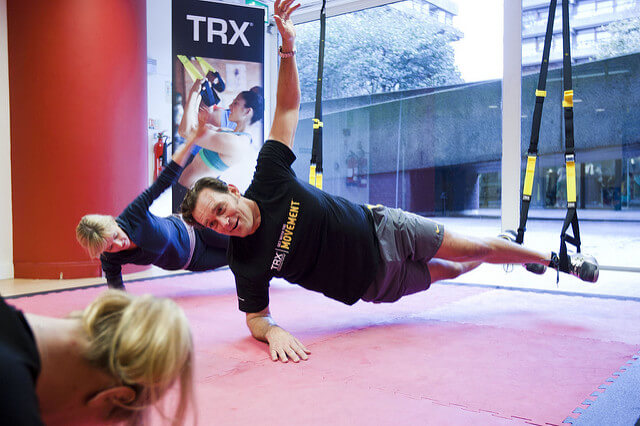
Pull is the pattern most desk-bound people are missing, which is why the row is usually the first exercise worth learning.
Hit all seven in a week and you’ve trained your whole body without ever writing the words “chest day” on a plan. If you want to go deeper into individual muscle groups, the site has focused guides on TRX triceps exercises, biceps work on the straps and explosive leg exercises.
What TRX trains well — and what it doesn’t
Any tool that claims to do everything is being sold to you. Here’s the honest split.
What it does well
- Trunk strength on every single rep. Not as a separate ab block at the end — as a tax on every exercise you do.
- Pulling strength. Rows at every angle, with no bench, no cable stack and no weight to load.
- Scaling for mixed abilities. Two people of wildly different strength can do the same exercise side by side, at different foot positions.
- Single-leg and single-arm work. The straps give just enough support to make unilateral training accessible before you’re strong enough to do it free.
- Training anywhere. A hotel room, a garage, a park, a ship. This is what it was designed for.
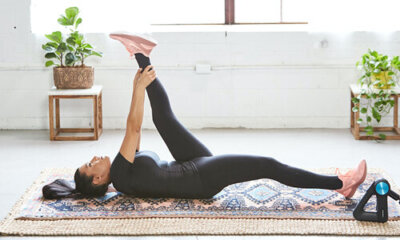
- Assisted mobility work. Hanging onto something stable lets you get into ranges you can’t hold on your own. More on that in the guide to types of stretching.
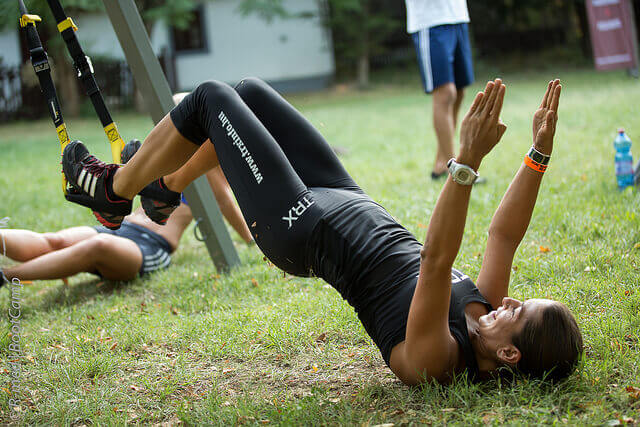
Suspended plank variations are where the instability of the tool stops being an inconvenience and starts being the point.
What it doesn’t do well
- Heavy lower-body strength. This is the real ceiling. Your legs can already handle your bodyweight — a squat where the straps are taking weight off you is not a heavy squat. A loaded barbell squat trains something a strap can’t.
- True isolation. Everything is a compound movement with a stabilization tax attached. You will never isolate a muscle the way a cable machine does.
- Resistance in every direction. The load always comes from gravity, so you can only be loaded in directions that involve falling. Pure horizontal resistance isn’t something a strap can give you.
- Cardio on its own. You can build a circuit that raises your heart rate, but it’s a strength tool. If conditioning is the goal, pair it with something like skipping rope.
- Training without an anchor. No solid overhead point, no session. That’s a real constraint, not a footnote.
So: does TRX work? Yes, for the things above, and it works the same way anything else works — progressive overload, meaning you keep making it harder over time. Stay at the same angle and the same rep count forever and progress stops, exactly as it would with dumbbells.
Who TRX is for — and who should wait
It’s a good fit if you’re:
- A complete beginner. This is one of the friendliest tools there is, because you can regress any exercise to almost nothing by standing more upright. Someone who can’t do a push-up on the floor can press at a near-vertical angle on day one.
- An older adult. Having something solid in your hands changes what’s possible. Squats, lunges and rows become approachable when there’s a handle to hold, and you’re never far from a stable position.
- Coming back from injury. The straps regress beautifully, which is why physical therapists use them. Read that as a note about the tool, not as permission — your rehab plan comes from the professional treating you, not from an article. If your issue is the lower back, start with the lower back exercise guide.
- Short on space or always traveling. The whole system fits in hand luggage.
- An experienced athlete. Single-leg work, slow tempos, explosive variations and rotational patterns all have plenty of headroom. Just don’t expect the straps to replace your heavy lower-body work.
- A trainer or coach. One tool, one exercise, and every client in the group is at their own intensity based on where their feet are.
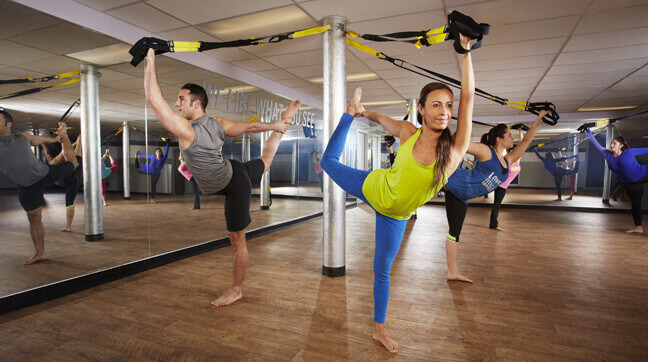
Holding onto a stable point lets most people reach a range they can’t control unsupported — useful at the end of a session.
Wait, or get cleared first, if:
- You have an acute or unresolved shoulder, elbow, wrist or lower back injury
- You have uncontrolled high blood pressure or a recent cardiac event — several exercises put your head below your heart
- You’re pregnant — the supine positions and deep trunk flexion need modifying
- You get dizzy or have a balance disorder
- You don’t yet have an anchor you’d trust with far more than your bodyweight
⚠️ Sharp pain in a joint means stop the exercise. Muscle burn is fine. Joint pain isn’t.
What you need to start
Three things, and only one of them costs money.
1. The suspension trainer
Any current model runs any beginner program. The differences between models come down to where you’ll train and how much wear the straps take — home models pack smallest, tactical models are built for rough outdoor anchors, pro models take commercial use. The full breakdown is in the TRX Suspension Trainer comparison.
2. An anchor point
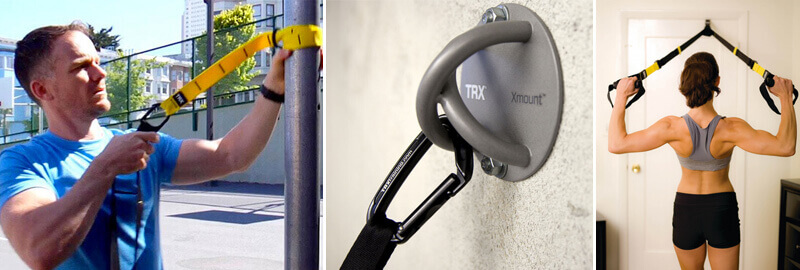
You need a fixed point roughly 7 to 9 feet (2.1 to 2.7 m) above the floor that holds far more than you weigh. A door works. So does a ceiling mount, a beam, a pull-up bar, a sturdy branch or a squat rack. Options run from permanent to fully portable — the TRX anchoring guide walks through all of them plus the safety checks.
3. Floor space
About 8 by 6 feet (2.4 by 1.8 m) of clear floor in front of the anchor covers everything in a normal session. A mat helps for the floor-based work.
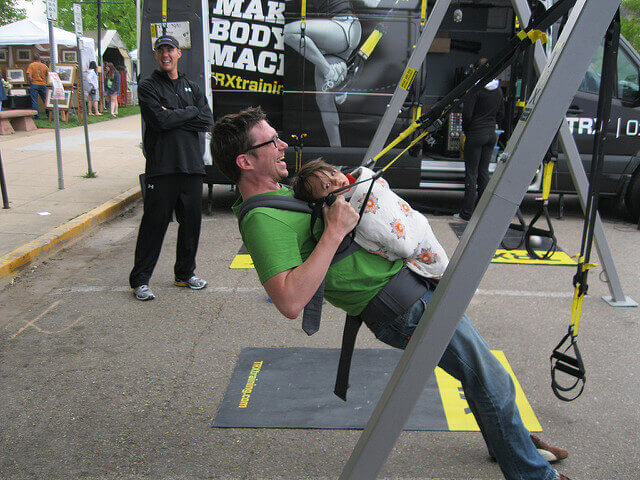
Packed down, the whole system weighs about as much as a pair of running shoes — which is why it survives in a suitcase.
💡 Before every session: check the straps for fraying, check the anchor is solid, and make sure the straps aren’t twisted. The yellow marks on both straps should sit at the same height. The straps are NOT a pulley — DO NOT perform sawing motions with them.
Gear I actually use
on any TRX® order — use this code at checkout
TRX15LUKASApplies to all TRX products — suspension trainers, training tools, apparel, education and apps.
Swipe or scroll sideways for more picks →
TRX® HOME2 SYSTEM
The all-rounder for training at home
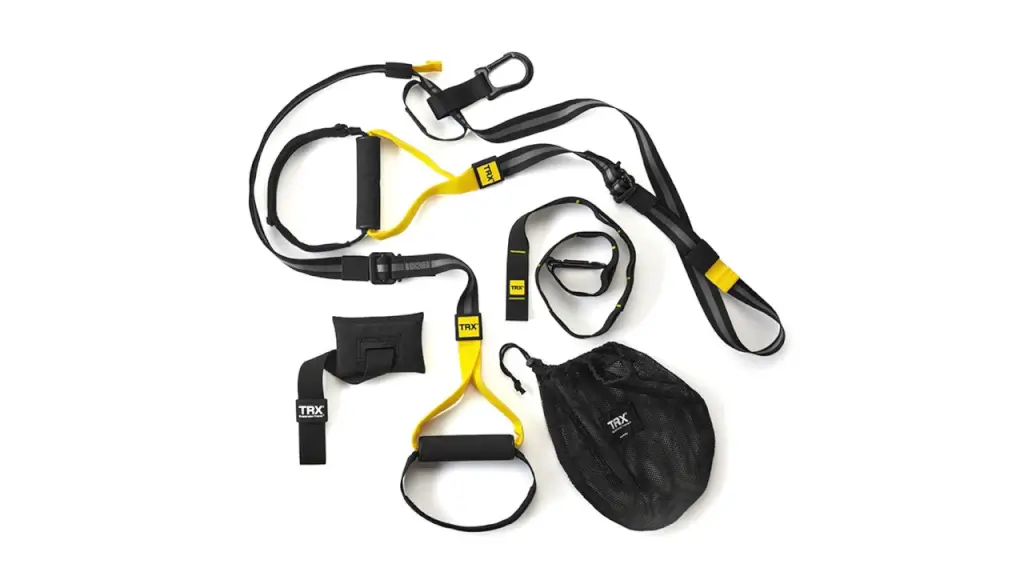
- ✓Door anchor, suspension anchor & mesh bag included
- ✓Free 30-day trial of the TRX App
- ✓Sets up anywhere in seconds, no tools needed
TRX® PRO4 SYSTEM
Built for heavy use and for trainers
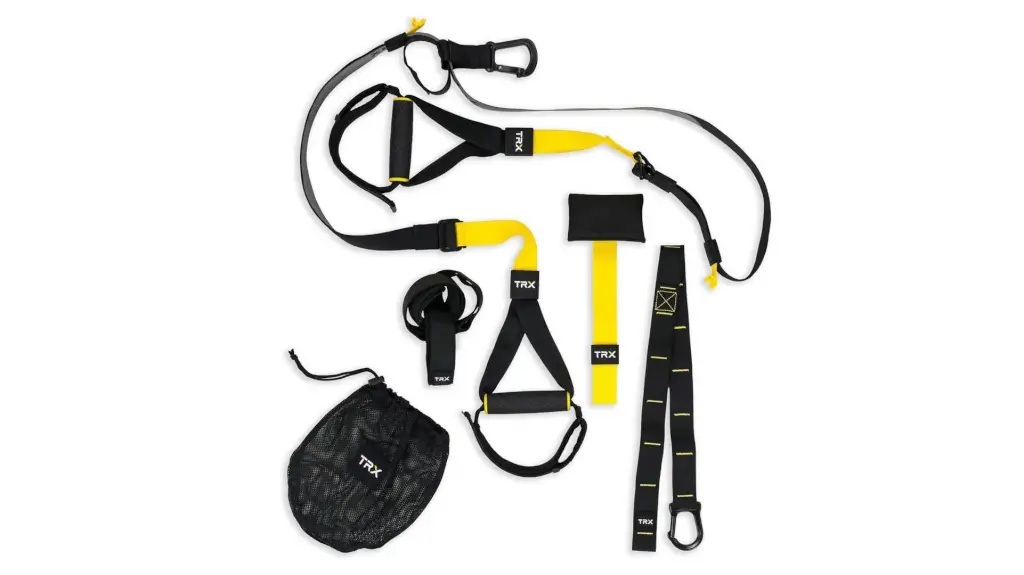
- ✓Door anchor, suspension anchor, Xtender & bag
- ✓Locking carabiner for a secure anchor point
- ✓Rubber handles that resist sweat and friction
TRX App™ Programs
If you have the straps but not a plan
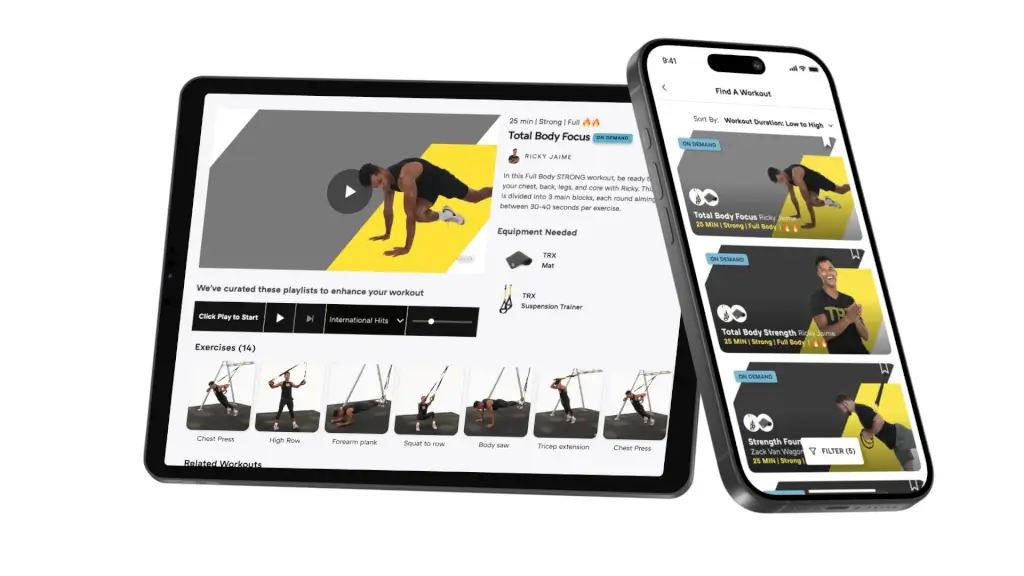
- ✓10+ structured on-demand training programs
- ✓Free 30-day trial, cancel any time
- ✓HSA/FSA eligible
YBell®
Four tools in one, for small spaces
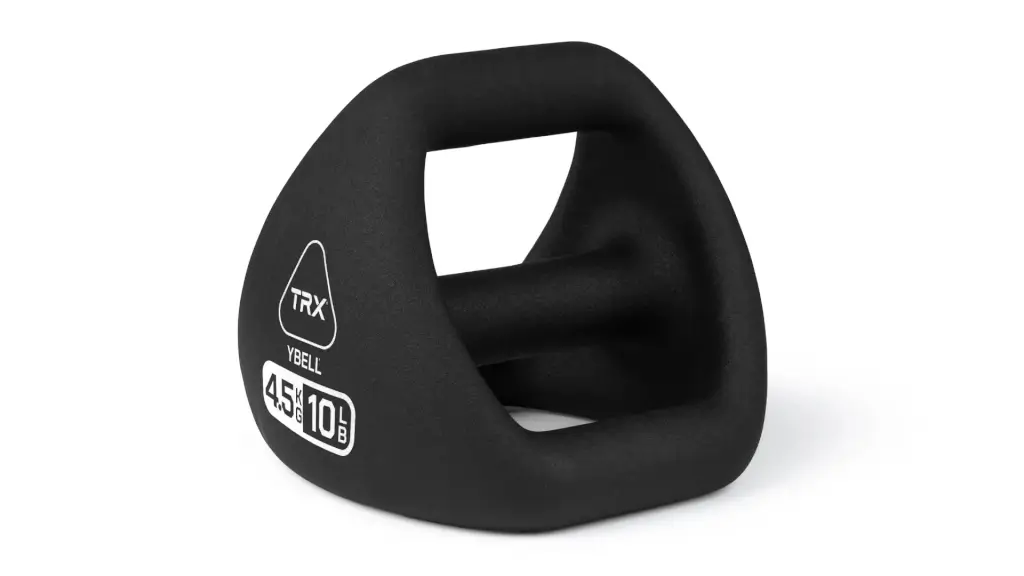
- ✓Dumbbell, kettlebell, med ball and push-up stand
- ✓Neo Series: 2.4–27 lbs (1.1–12 kg)
- ✓Pro Series: 10–44 lbs (4.5–20 kg), 2-year warranty
TRX® RIP TRAINER™
For rotational power and a stronger core
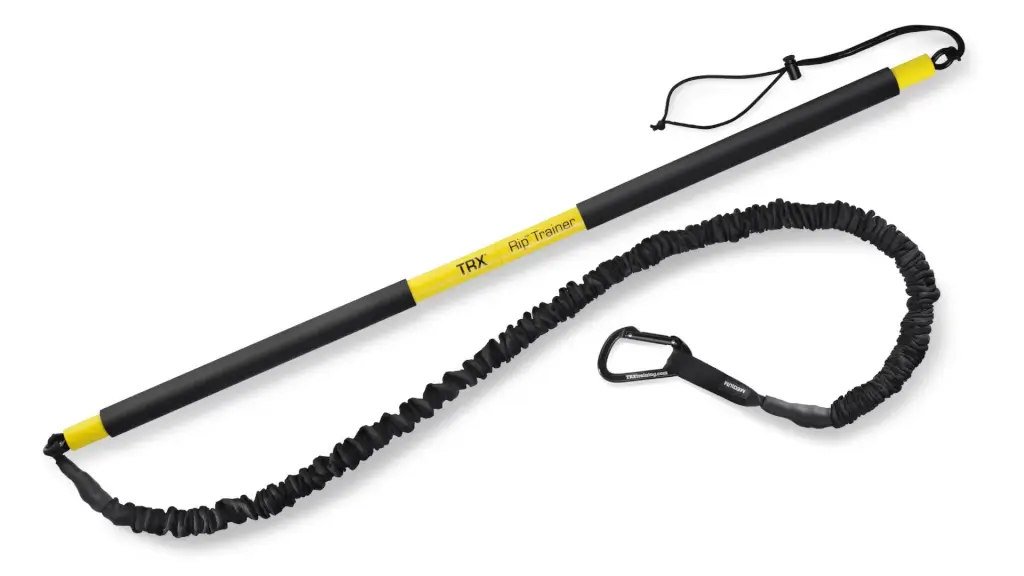
- ✓Door anchor, resistance cord & safety strap included
- ✓Built for rotation — golf, tennis, baseball
- ✓Packs into a backpack, set up in seconds
Disclosure: the links above are affiliate links. If you buy through them, I may earn a commission at no extra cost to you — and you still get 15% off with code TRX15LUKAS. I only recommend gear I actually use. Prices and availability are shown on trxtraining.com and can change.
Your first TRX workout
Six exercises, two rounds, about 20 minutes. It covers six of the seven patterns and it’s deliberately conservative — the point of session one is to learn where your feet go, not to get sore.
| # | Exercise | Pattern | Sets × reps | Strap length | Start position |
|---|---|---|---|---|---|
| 1 | TRX Assisted Squat | Squat | 2 × 10 slow | Mid-length | Standing, facing the anchor |
| 2 | TRX Low Row | Pull | 2 × 8–10 | Short | Standing, facing the anchor, leaning back |
| 3 | TRX Chest Press | Push | 2 × 8–10 | Long | Standing, facing away from the anchor |
| 4 | TRX Assisted Lunge | Lunge | 2 × 6 each leg | Mid-length | Standing, facing the anchor |
| 5 | TRX Hamstring Curl | Hinge | 2 × 8 | Mid-calf | Lying on your back, heels in the foot cradles |
| 6 | TRX Plank | Plank | 2 × 20 sec | Mid-calf | Forearms on the floor, both feet in the cradles |
Rest 30 to 45 seconds between exercises and a minute between rounds. Two to three sessions a week on non-consecutive days.
Three rules for session one:
- Set your body angle before the first rep, not during the set. Pick a position you can control for all the reps.
- Keep the straps taut. Slack means you’ve lost the tension the exercise depends on.
- If a set gets ugly, step back. Literally — one step away from the anchor and the exercise gets easier immediately.
When this stops feeling like enough, move to the full 30-minute whole-body TRX workout, which has 15 exercises with technique, common mistakes and a four-week progression.
↓↓↓ Download the 30-minute TRX workout [PDF] ↓↓↓
Five things people get wrong about TRX
Myth 1: it’s just a core tool
Your trunk works on every rep, which is where the reputation comes from. But the method is built on seven patterns and only one of them is the plank. Rows, presses, squats, lunges, hinges and rotations are all in there.
Myth 2: it’s only for advanced trainees
It’s the opposite. Standing more upright regresses any exercise to almost nothing, which makes it one of the easiest tools to start on. The photos of people holding themselves horizontal are the top of the range, not the entry point.
Myth 3: resistance bands do the same thing
They don’t, and the difference is the resistance curve. A band is hardest at the end of the movement, where it’s stretched furthest. A suspension trainer is hardest at the start, where your body angle is most extreme. They’re complementary, not interchangeable — the full comparison is in TRX vs resistance bands.
Myth 4: bodyweight training isn’t real strength training
Resistance is resistance. What matters is whether the load is hard enough and whether it keeps increasing. On a suspension trainer you increase it with your feet instead of with plates. The honest caveat is the one above: for heavy lower-body work you’ll run out of runway, because your legs can already handle your bodyweight.
Myth 5: you need a ceiling mount
A door anchor takes about ten seconds to set up and needs no tools, no drilling and no landlord conversation. A ceiling mount is nicer if you train at home every day, but it’s not the price of entry. See the anchoring options.
Where to buy a TRX — and how to get 15% off
Disclosure: This post contains affiliate links. If you buy through them, I may earn a commission at no extra cost to you — and you get 15% off with my code TRX15LUKAS. I only recommend gear I actually use.
Buy genuine, and buy from an official channel. Counterfeits fail at the stitching and at the cam buckle, which is exactly where you don’t want a failure while your feet are off the floor. The genuine vs counterfeit guide shows you what to check before you pay.
🎁 Use code TRX15LUKAS for 15% off any TRX product — suspension trainers, training tools, apparel, education and apps. Here’s how to apply the TRX discount code at checkout.
If you’re not sure which model fits your situation, start with the model comparison rather than the price tag. Where you’ll anchor it matters more than the badge on the strap.
Where to go next
This page is the map. Here’s the territory:
- Hang it safely. TRX anchoring solutions — doors, ceilings, beams, trees, and the safety checks for each.
- Pick a model. TRX Home vs Pro vs Tactical.
- Train. The 30-minute whole-body workout, or browse every plan on the site in TRX workouts.
- Don’t get burned. How to spot a counterfeit.
- Learn to coach it. TRX professional education courses.
- Save 15%. The TRX discount code.
TRX FAQ
Start with one thing
You don’t need to understand the whole system before your first session. You need an anchor you trust and one exercise you can control.
Hang the straps, set them short, face the anchor and do ten slow rows at an angle that feels easy. That’s the entire method in one set: your bodyweight, your body angle, and one step forward when it stops being hard.
Then come back for the rest of the workouts.