

🎁 How to apply the TRX Training Discount Code

Fake TRX: How to Tell a Genuine TRX From a Counterfeit
The fastest way to tell a fake TRX from a real one takes about thirty seconds and costs nothing. Slide the rubber TRX badge above the handle up and away from the grip. On a genuine TRX Suspension Trainer there is a serial number sewn onto the strap underneath it. Enter that number on the TRX product registration page. If there is no serial number, or the number will not register, you are not holding a TRX.
Everything else on this page — the stitching, the carabiner, the handles, the packaging — is a supporting clue. The serial number is the decision.
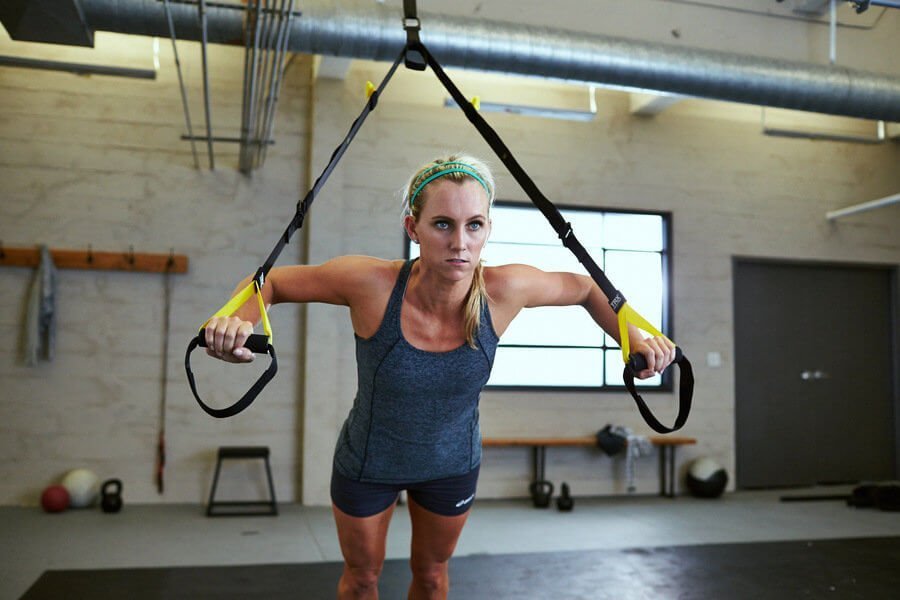
Side by side the copy looks convincing, which is exactly the problem — the decision has to come from the serial number, not from the silhouette.
Who this page is for
You’re in the right place if one of these is you.
- You already bought something and the price now feels too good. Start with the 30-second check below.
- You’re about to buy and the listing looks slightly off. Read the section on where counterfeits get sold.
- You’re a trainer and a client wants to bring their own straps to a session. Read the safety section before you say yes.
Bought direct from TRX and the box arrived sealed? Register the serial anyway, then get on with your TRX workouts.
The 30-second check
Three steps, in this order. Stop at the first one that fails.
- Find the rubber badge on the strap just above the handle. Slide it up, away from the grip.
- Look for a serial number sewn onto the strap underneath it, on a small transparent label. No label, no number, no further discussion.
- Register the number with TRX. The registration page exists specifically to confirm authenticity, and it takes an email address and the number. A number that doesn’t exist in their system is the answer.
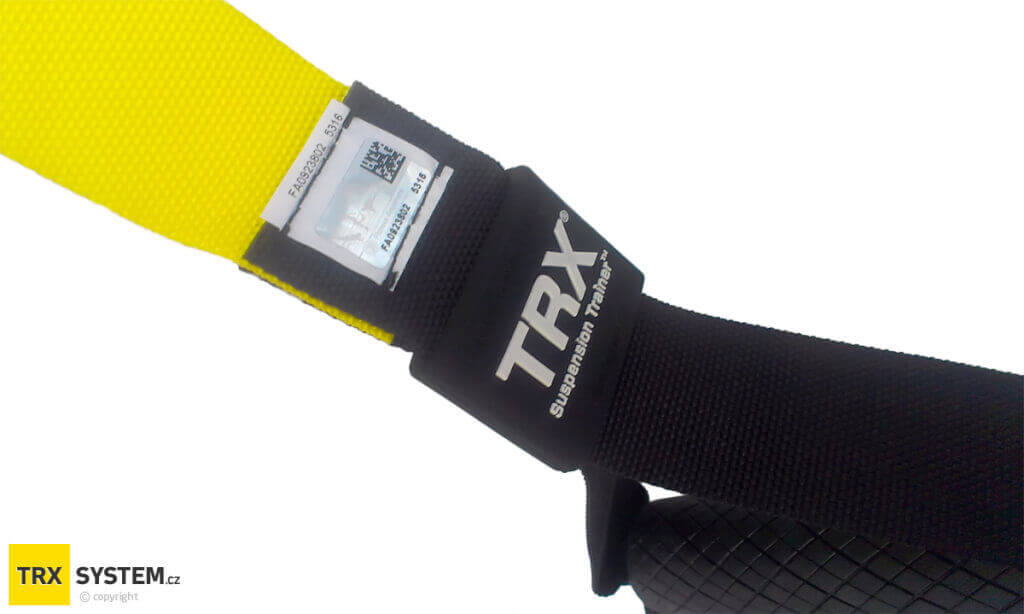
The badge slides — it isn’t glued down. If yours won’t move, that on its own is worth a second look.
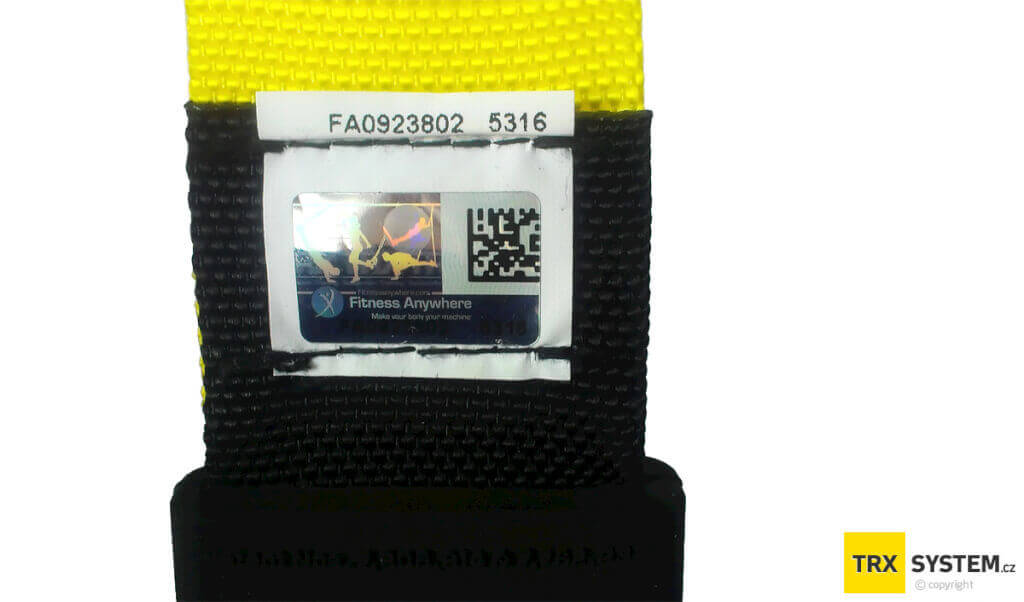
Photograph this label before you register it — if you ever file a warranty claim, this is the first thing you’ll be asked for.
A counterfeit can copy a logo, a color and a shape. Copying a serial number that resolves in the manufacturer’s own database is a different problem, and it’s why this check is the one that matters.
- On suspension exercises your center of mass sits outside your base of support. That’s the whole point of the tool — the trunk works because the body is on the edge of falling and keeps choosing not to.
- In a TRX Chest Press your hands are the only thing between your face and the floor. In a TRX Low Row you’re leaning back with your heels dug in and nothing behind you.
- Load on a suspension trainer is never static. Every rep is an acceleration and deceleration cycle, so peak force at the anchor is higher than your bodyweight, and it repeats hundreds of times per session.
- Webbing, stitching and hardware fail the way all materials fail: gradually and invisibly, then all at once under a normal rep.
Why it works: a barbell that’s too heavy stops you at the bottom of the rep. A suspension trainer that fails removes the support entirely, mid-movement, while you’re already committed. There’s no intermediate step between training and impact — which is why the hardware is not the place to save money.
Original vs fake: the full checklist
Go down this list in order. Anything above the line is decisive. Everything below it is a clue that should make you look harder.
| What to check | ✅ Genuine TRX | ❌ Typical counterfeit |
|---|---|---|
| Serial number | Sewn onto the strap under the rubber badge above the handle, on a transparent label, and it registers with TRX | Missing, printed instead of sewn, or a number that won’t register |
| Rubber badge | Slides freely so you can reach the label underneath | Fixed, glued, or covering nothing at all |
| Carabiner | Locking gate that closes cleanly and stays closed under load | Soft metal that bends out of shape, so the gate no longer aligns and can’t lock |
| Stitching at the main carabiner | Dense box stitching along the load-bearing loop | Little or no stitching along the loop, or a single line of thread doing all the work |
| Stitch spacing | Even, symmetrical, identical on both straps | Uneven gaps between stitch lines, one strap different from the other |
| Webbing edges | Cleanly finished, sealed, no loose fibers | Frayed ends, rough cuts, threads already lifting on a brand new unit |
| Handles | Dense foam on the HOME2, textured rubber on the PRO4 — firm, easy to clean, anti-slip | Soft, hollow-feeling grips that scratch with a fingernail or a ring |
| Foot cradles | Hold their shape, stitched into the strap, don’t collapse when empty | Flimsy, wrongly sized, stitched on rather than in |
| Adjusters and cam buckles | Lock instantly and hold with no creep during a set | Slip under load, so one strap slowly gets longer mid-exercise |
| Packaging | Sealed retail box, handles held with a printed paper band, product card with a scratch panel | Plastic bag, generic box, no card, or a box with printing that doesn’t match the product inside |
| Manual | Printed setup and safety guide, correct model name throughout | Missing, photocopied, or referring to a model you didn’t buy |
| Seller | TRX directly, or a dealer on the official partner list | No company details, no address, product listed as cheap TRX, photos lifted from the official site |
1. The carabiner is where counterfeits fail first
The carabiner carries everything: your bodyweight, the acceleration of every rep, and the shock load at the bottom of a movement.
On the copies I’ve had in my hands, the metal is the giveaway. It deforms instead of holding, and once the gate is out of alignment it can’t lock — so the strap can come off the anchor while you’re loaded.
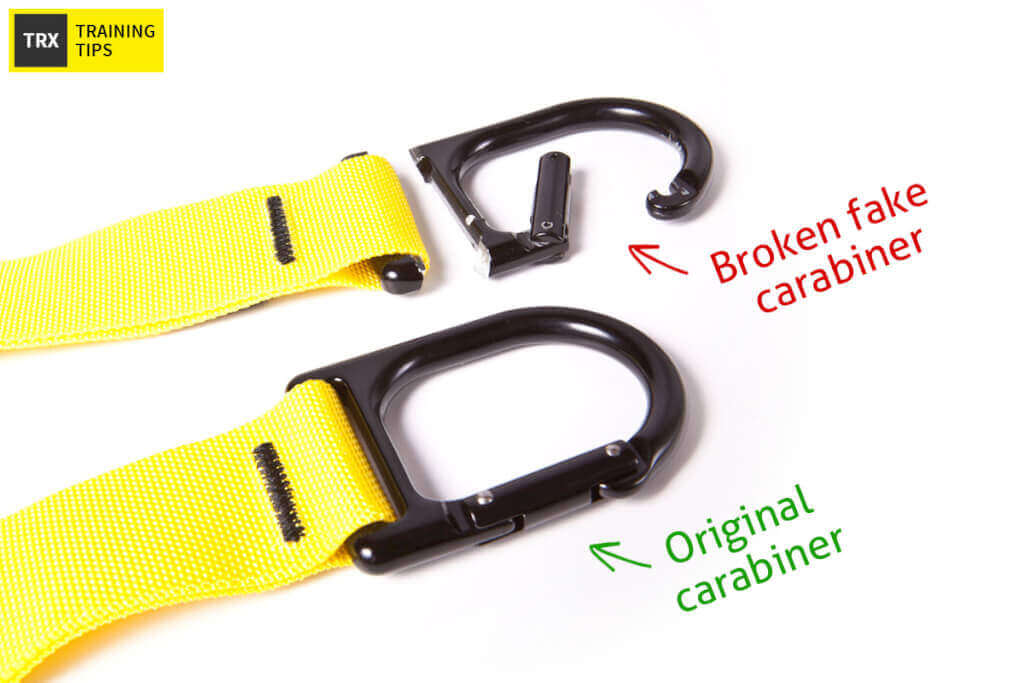
This is what a broken carabiner looks like after the fact. Nobody saw it coming during the previous set either.
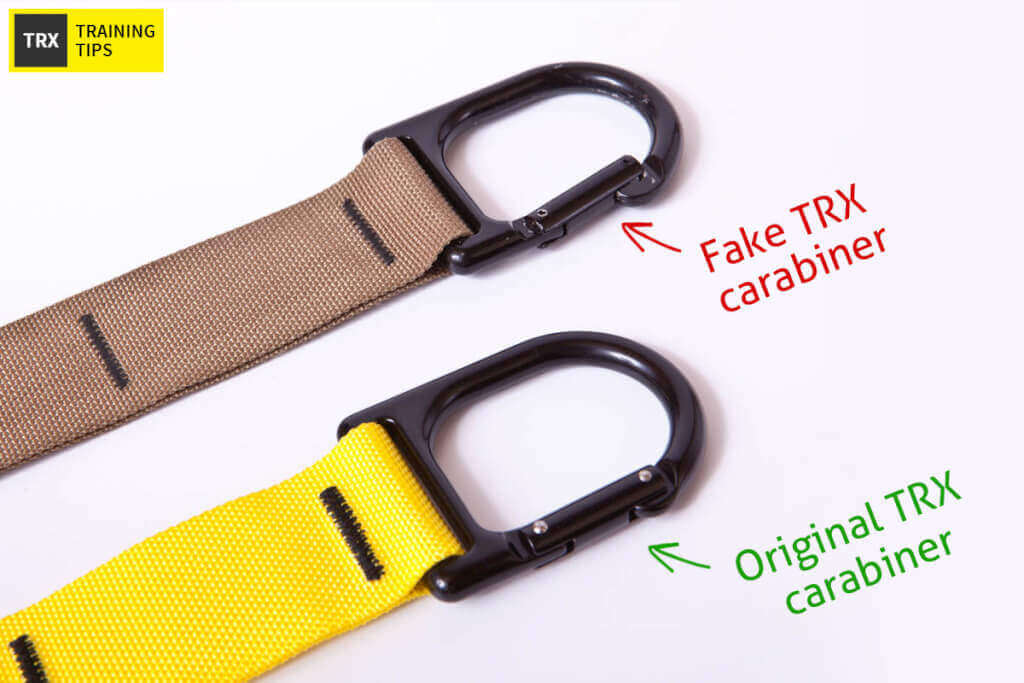
Once the gate no longer meets the nose, the carabiner is an open hook — check this before every session, on any brand.
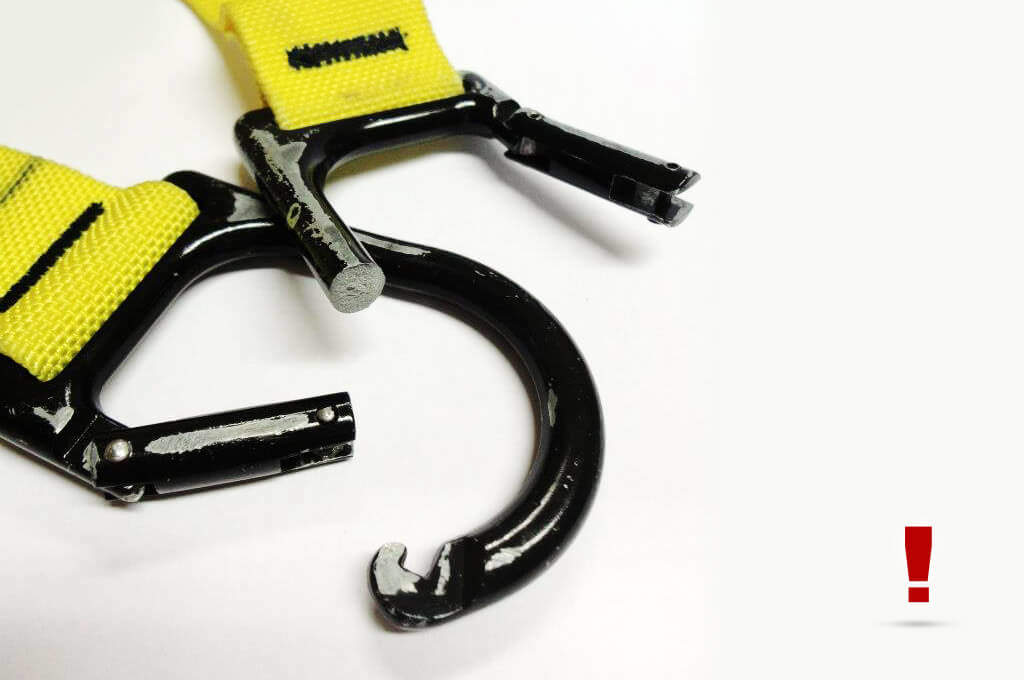
Good hardware bends before it breaks and gives you warning. Bad hardware does both at the same moment.
2. Stitching tells you more than the logo
Logos are trivial to copy. Load-bearing stitching is not, because it costs thread, machine time and quality control.
Look at the loop that holds the main carabiner. On a genuine unit it’s densely box-stitched. On copies, that seam is often thin, short, or simply absent — and the rubber badges sit at different distances on the left and right strap, which tells you the two sides weren’t made to the same jig.
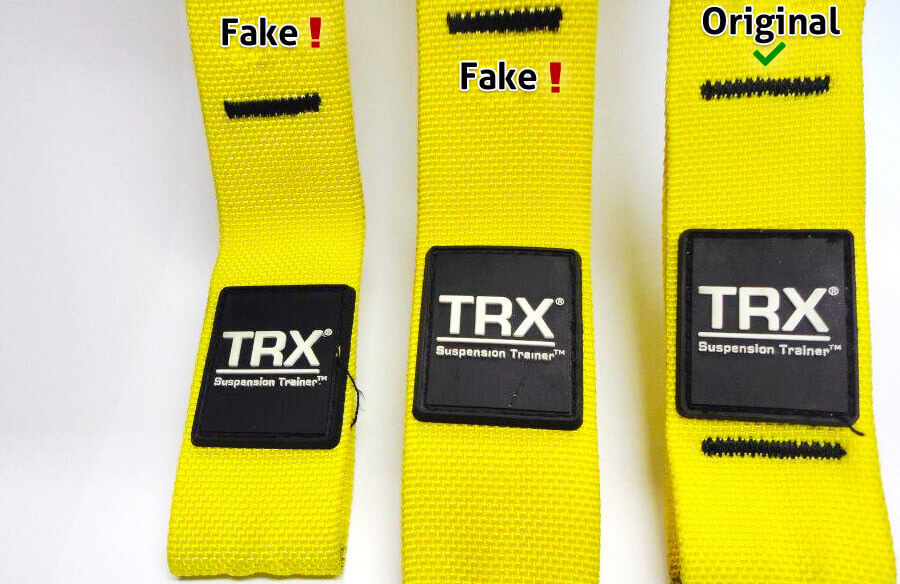
Hold both straps next to each other. Asymmetry between the left and right side is the cheapest counterfeit test there is.
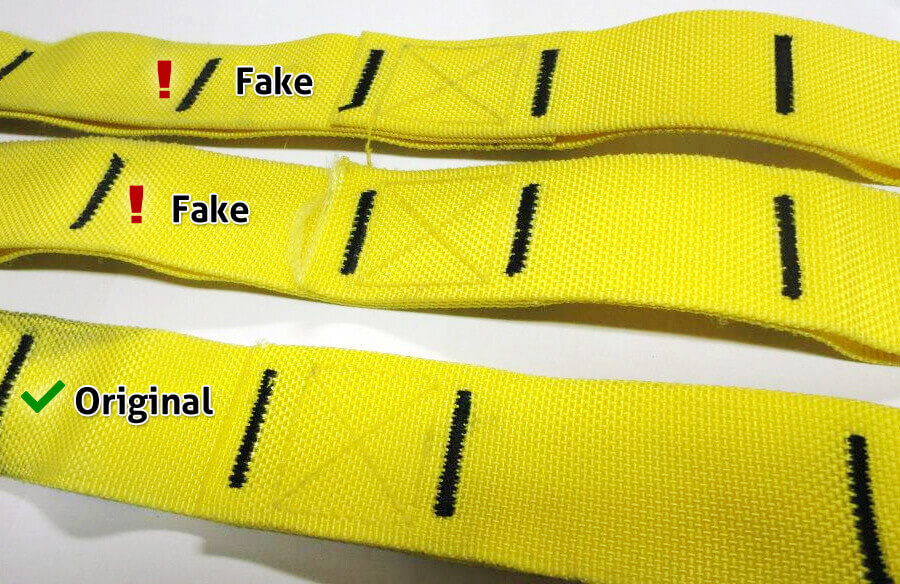
Fraying on a brand new unit is not cosmetic — it’s the start of the failure, and it only goes one direction.
3. Handles and foot cradles
The current lineup uses dense foam handles on the TRX HOME2 System and textured rubber handles on the TRX PRO4 System. Both are firm, easy to wipe down and grippy when your hands are wet.
Counterfeit grips feel soft and hollow. You can mark the surface with a fingernail or a ring, and once the surface is broken, sweat gets in and it never comes clean again.
If you’re not sure which model you’re looking at in the first place, our comparison of the current TRX Suspension Trainers shows what belongs on each one.
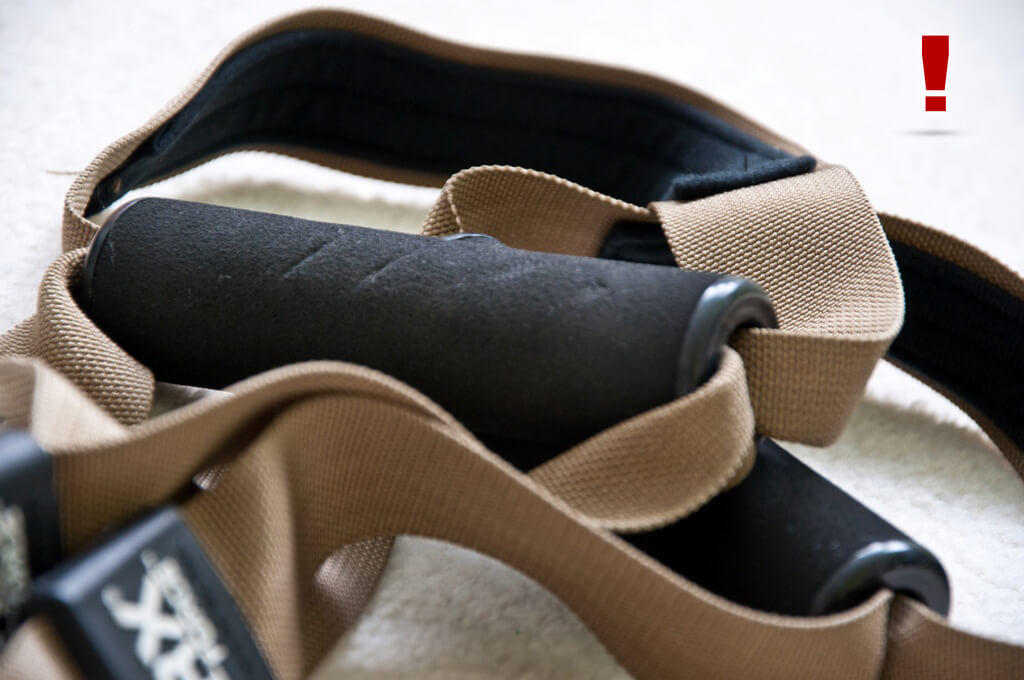
Counterfeit grips on a copy of the TRX FORCE Kit — the surface marks with a fingernail.
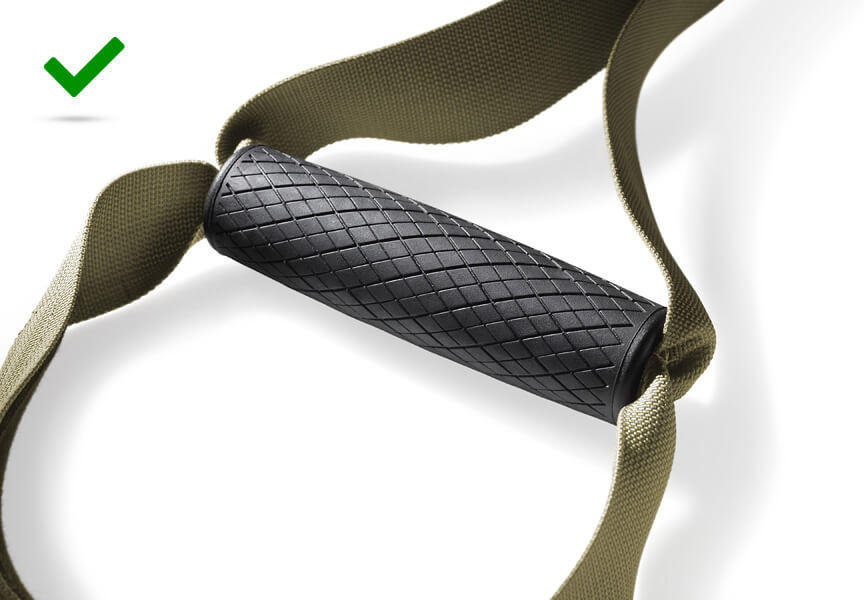
The original handles on the same model — this is the texture your hands should meet.
4. Packaging is a clue, not proof
A new unit arrives with the handles held together by a printed paper band, and the box includes a product card with a scratch panel hiding a registration code.
Packaging changes over the years and counterfeiters copy boxes too, so treat this as supporting evidence only. The sewn serial number is the constant.
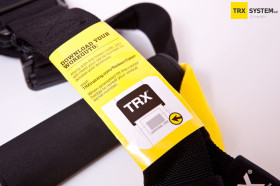
If someone sells you a new unit with the band already removed, ask why.

Scratch it, register it, then keep the card. Registration is what activates the extended warranty.
This is not about money. It’s about what you’re hanging from.
Here’s the part people skip.
The reason counterfeits sell is that the retail price feels high, and a near-identical product for a fraction of it looks like a smart trade. If nobody can tell the difference, why pay full price?
Somebody always tells the difference. In the better case it’s your own body that finds out. In the worse case it’s your client’s body — a torn muscle, or a face that meets the floor from chest height.
A strap doesn’t fail while you’re standing next to it. It fails mid-rep, with your weight already committed and your hands occupied. You don’t get to react.
If you coach, this is not just your risk. Training a paying client on equipment the manufacturer explicitly does not stand behind is a question worth putting to your insurer before it becomes a question someone else puts to you.
TRX itself is blunt about it in its own warranty policy: there is a large volume of counterfeiters claiming to sell genuine TRX products, and buyers should beware because those products may be unsafe and of poor quality. The same document states that TRX does not warrant gray market goods, used goods, or goods sold by any unapproved third party — even if the package is unopened.
So a counterfeit isn’t a cheaper TRX. It’s a different product, with no warranty, no registration, no recourse, and an unknown failure point — used for exercises where failure means a fall.
Where counterfeits get sold
I’m not going to name companies, and you should be suspicious of any article that does without evidence. What I can describe is the type of channel where copies keep showing up.
- Marketplaces where any seller can create a listing. The platform is legitimate; the seller behind the listing may not be. A brand name in the title guarantees nothing.
- Auction sites and classifieds, especially for units sold as new but without a box.
- Shops with no identifiable operator — no company registration, no address, a contact form and nothing else.
- Listings that only use official product photos. If there isn’t one real photo of the actual item, you don’t know what ships.
- Listings built around the word cheap. A fraction of retail isn’t a discount on a suspension trainer. It’s information about what’s in the box.
Sellers in this category often describe themselves as approved resellers. That’s checkable: TRX publishes its list of official international partners. If they’re not on it, they’re not it.
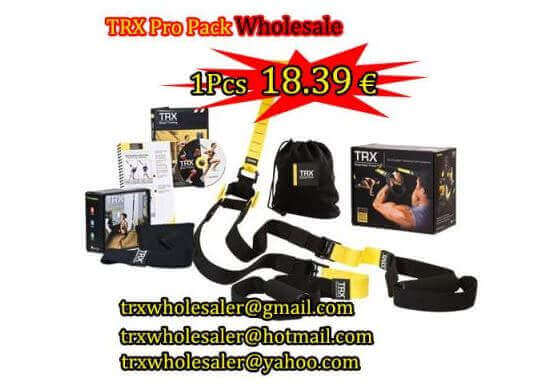 Listed as a TRX. Note the hardware. |
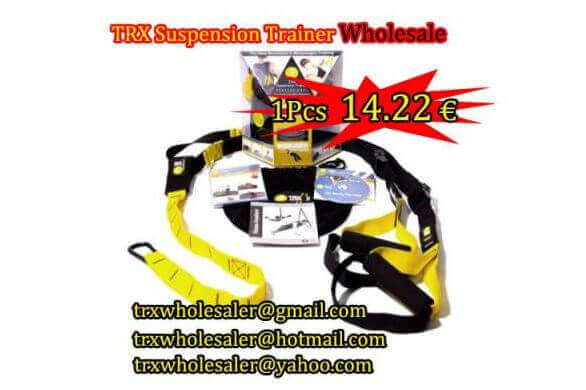 A complete counterfeit kit, sold as an original. |
One more thing worth separating: a counterfeit and a gray market item are not the same problem. A gray market unit may be genuine but sold outside the authorized chain — which, per the warranty policy above, still leaves you without warranty coverage. Different cause, same outcome when something breaks.
What to do if you already own a fake
If the serial check just went badly, work through this list. In this order.
- Stop training on it today. Not after this week’s sessions. Today.
- Don’t cut it up yet. Photograph it — the handles, the carabiner, the stitching, the missing label, the packaging and the listing itself.
- Contact the seller and ask for a refund on the grounds that the item isn’t what was described. Keep it in writing.
- If you paid by card or through a payment platform, open a dispute. Counterfeit goods are one of the clearest cases for a chargeback, and the clock on it is short.
- Report the listing to the marketplace. Brand protection teams act on reports; it’s the mechanism that actually removes listings.
- Do not resell it and do not give it away. Passing it to a friend just moves the injury to someone who doesn’t know what they have.
- Buy the replacement from a source you can verify — and register the serial number the day it arrives.
DO NOT keep a counterfeit as a spare or a travel set. The reason people get hurt on these is precisely that they only use them occasionally and never inspect them.
While you’re at it, check what you’re hanging it from as well. A perfect trainer on a bad anchor is the same accident — our guide to anchoring a TRX safely at home or outdoors covers what holds and what doesn’t.
Where to buy a genuine TRX
The simplest way to make this whole question disappear is to buy from the manufacturer. There’s no chain of custody to verify, the serial registers, and the warranty applies.
Disclosure: This post contains affiliate links. If you buy through them, I may earn a commission at no extra cost to you — and you get 15% off with my code TRX15LUKAS. I only recommend gear I actually use.
I’ve been coaching on TRX since 2011 and I’ve bought a lot of it. Use the code TRX15LUKAS at checkout for 15% off anything TRX sells — Suspension Trainers, anchors, training tools, apparel, education and app subscriptions. It’s my ambassador code, and it stays live.
👉 See how to apply the TRX15LUKAS discount code and check the current price.
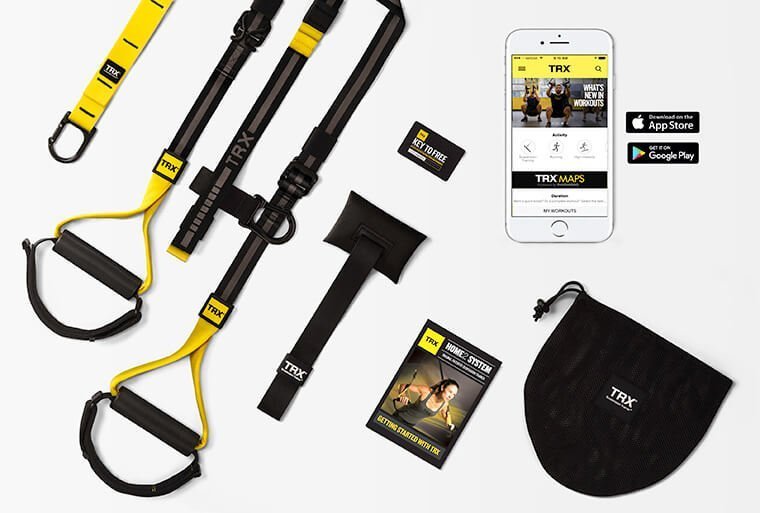
The HOME2 is the one most people should buy — foam handles are noticeably kinder to untrained hands.
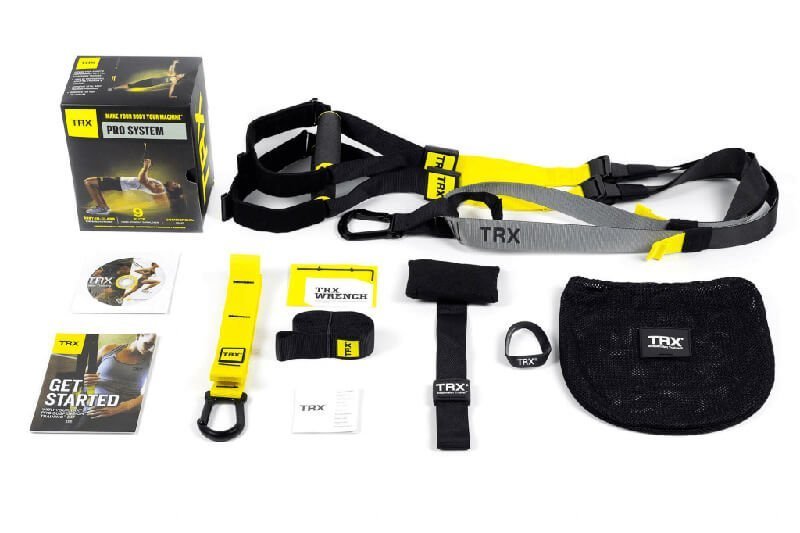
The PRO4 adds rubber handles and an Xtender, which matters if you train clients or train outdoors.
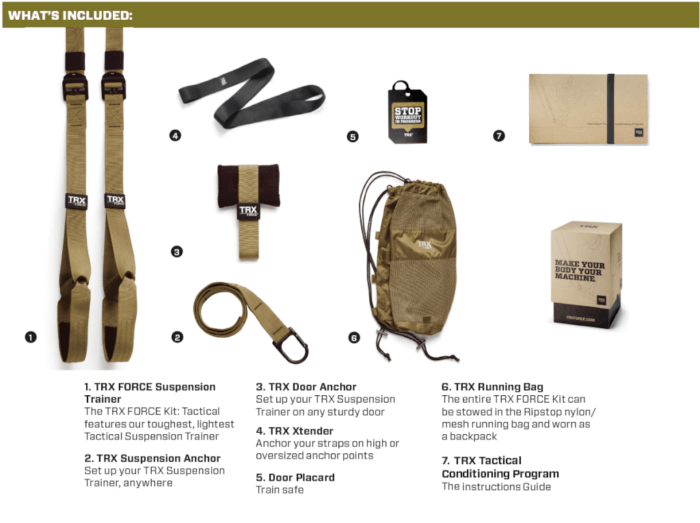
The Tactical Gym exists for boots and rough ground. Most people at home don’t need it.
Not sure which one fits you? Start with the model comparison, or read what a TRX Suspension Trainer actually is if you’re new to the tool. If you’re weighing it against a cheaper option in general, we also compared suspension trainers against resistance bands.
Once it arrives: register the serial number, hang it properly, and try the 30-minute full body workout — there’s a free PDF with it.
Gear I actually use
on any TRX® order — use this code at checkout
TRX15LUKASApplies to all TRX products — suspension trainers, training tools, apparel, education and apps.
Swipe or scroll sideways for more picks →
TRX® HOME2 SYSTEM
The all-rounder for training at home
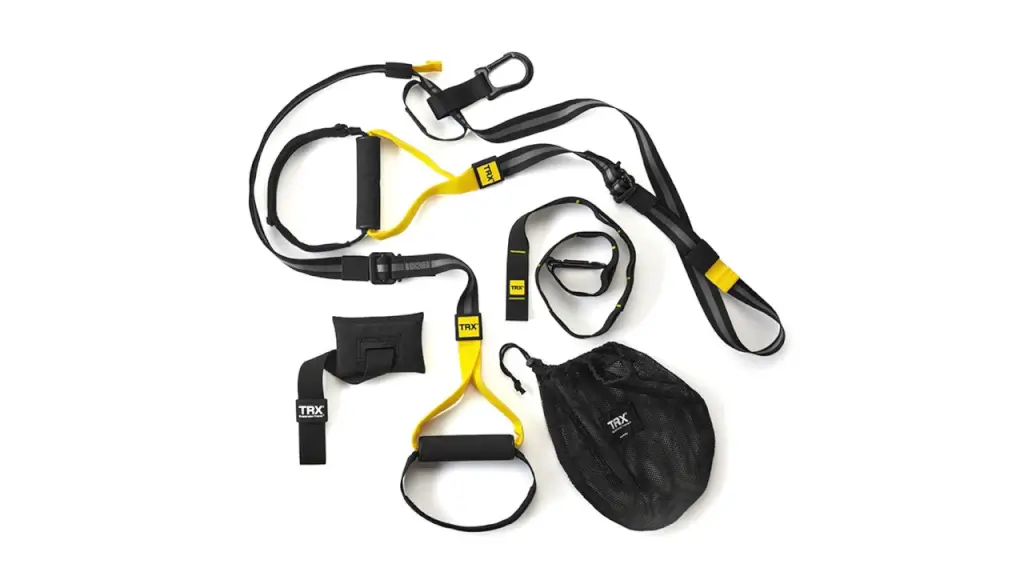
- ✓Door anchor, suspension anchor & mesh bag included
- ✓Free 30-day trial of the TRX App
- ✓Sets up anywhere in seconds, no tools needed
TRX® PRO4 SYSTEM
Built for heavy use and for trainers
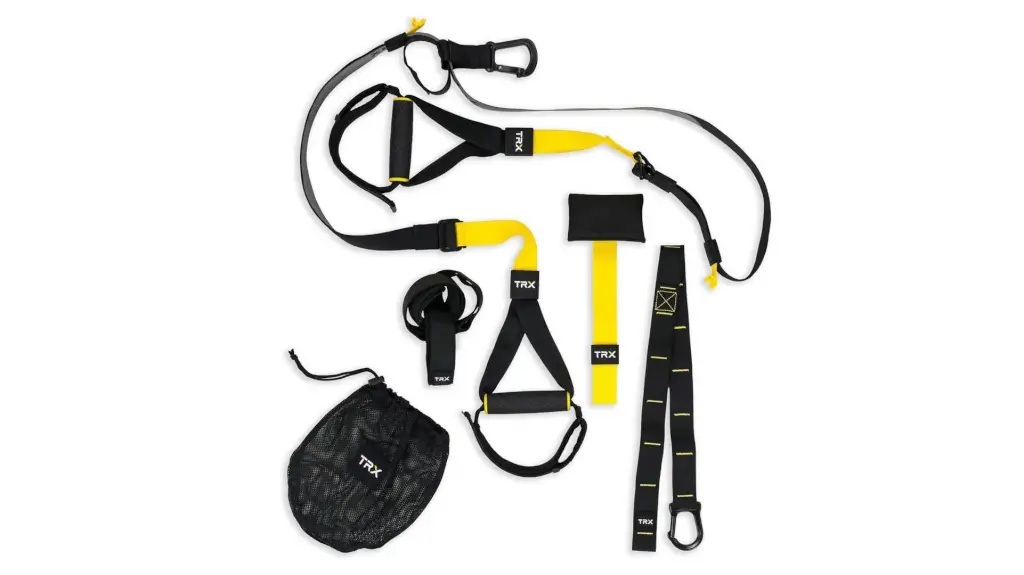
- ✓Door anchor, suspension anchor, Xtender & bag
- ✓Locking carabiner for a secure anchor point
- ✓Rubber handles that resist sweat and friction
TRX App™ Programs
If you have the straps but not a plan
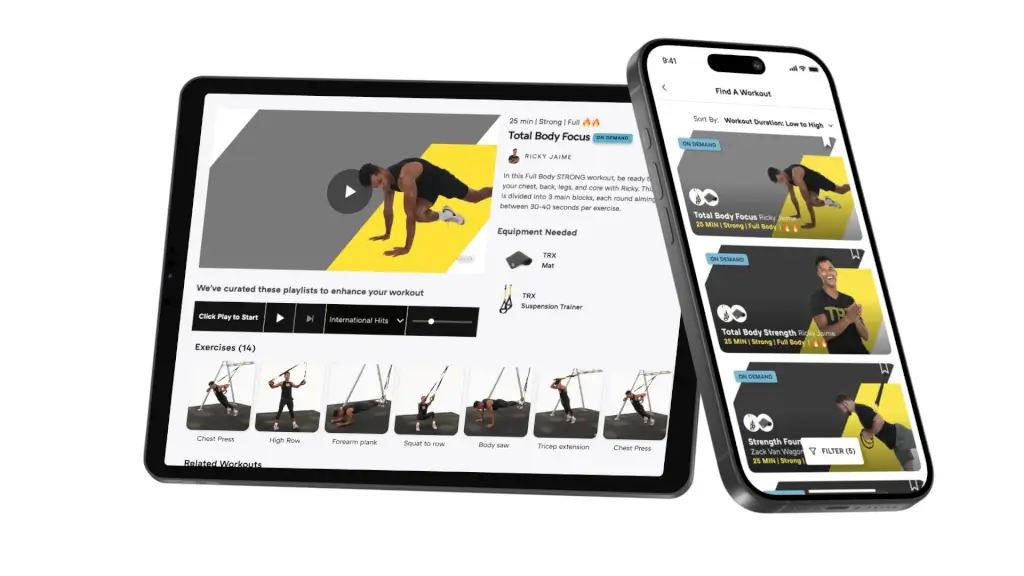
- ✓10+ structured on-demand training programs
- ✓Free 30-day trial, cancel any time
- ✓HSA/FSA eligible
YBell®
Four tools in one, for small spaces
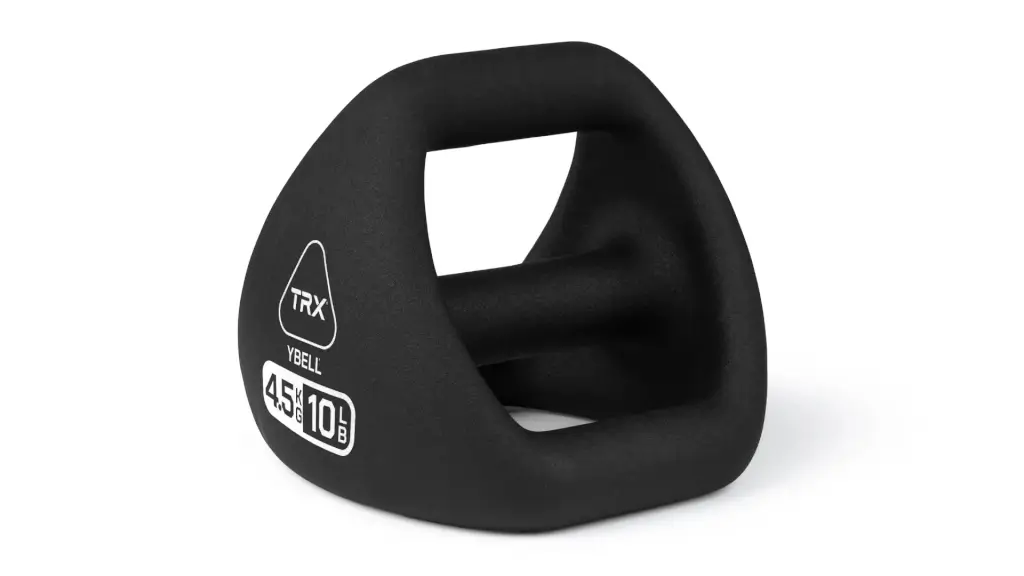
- ✓Dumbbell, kettlebell, med ball and push-up stand
- ✓Neo Series: 2.4–27 lbs (1.1–12 kg)
- ✓Pro Series: 10–44 lbs (4.5–20 kg), 2-year warranty
TRX® RIP TRAINER™
For rotational power and a stronger core
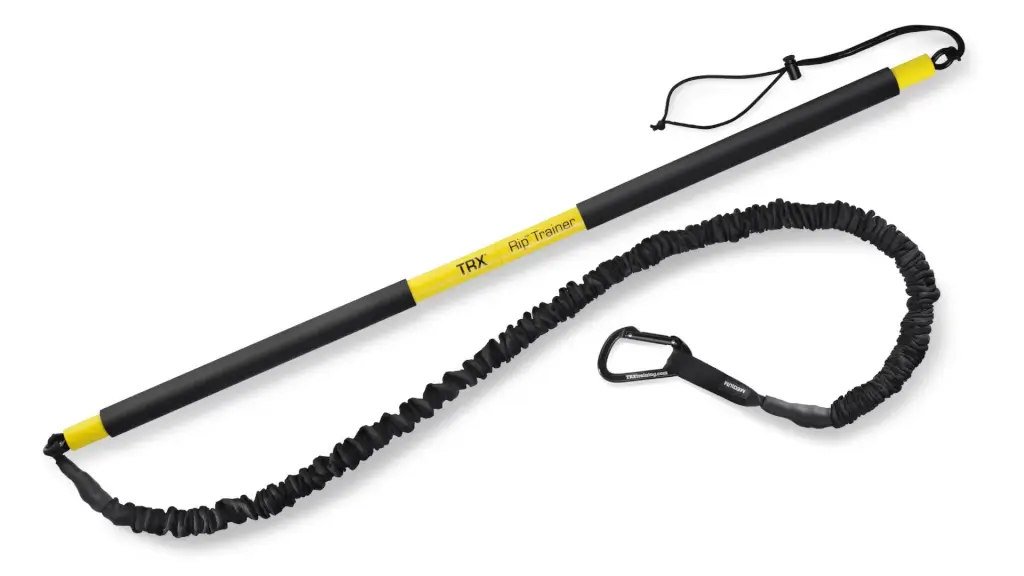
- ✓Door anchor, resistance cord & safety strap included
- ✓Built for rotation — golf, tennis, baseball
- ✓Packs into a backpack, set up in seconds
Disclosure: the links above are affiliate links. If you buy through them, I may earn a commission at no extra cost to you — and you still get 15% off with code TRX15LUKAS. I only recommend gear I actually use. Prices and availability are shown on trxtraining.com and can change.
Frequently asked questions
The short version
Slide the badge. Find the number. Register it.
Stitching, handles and carabiners will train your eye, but counterfeits improve every year and an old photo can’t describe next year’s copy. A serial number can, because it has to exist in someone else’s database.
And if you are holding a fake, it isn’t the money that should move you. It’s that the next rep is the one where you find out.