

🎁 How to apply the TRX Training Discount Code

There are six main types of stretching, and they are not interchangeable. Static stretching holds a lengthened position still. Dynamic stretching moves a joint through its range over and over, under control. Active stretching means your own muscles hold the position. Passive stretching means something else holds it for you: gravity, a strap, or a partner. PNF stretching adds a short muscle contraction before you ease deeper. Ballistic stretching bounces at the end of the range, and it is the one most coaches now skip. Foam rolling is not stretching at all, but it belongs in the same conversation.
Here is the short version you can act on today: move before you train, hold after you train. The rest of this guide tells you when each type earns its place, when it doesn’t, and how long to stay there.

Move into every stretch slowly — a sudden pull triggers the exact reflex you are trying to quiet • photo: Vicky Timón • Encyclopedia of Pilates Exercises
Who this guide is for
It’s for people who train a few times a week, whether that’s lifting, running, or suspension training. It’s also for desk workers whose hips and chest feel welded shut by Friday.
It’s not a rehab program. If you’re recovering from a muscle tear or recent surgery, follow your physical therapist’s plan. Stretching does not treat injuries and it does not remove pain.
- Muscle spindles inside the belly of a muscle detect how fast and how far it lengthens. Move too quickly into end range and they trigger a protective contraction, the stretch reflex.
- Golgi tendon organs sit where muscle meets tendon and respond to tension instead of length. Sustained tension lets them dial the protective response down.
- That is why a slow, calm hold works and a sudden yank doesn’t. Rushing recruits the exact reflex you’re trying to quiet.
Why it works: most of the range you gain in a single session comes from your nervous system tolerating the position better, not from the muscle becoming permanently longer. Real structural change takes weeks of consistent work, which is why one heroic session before a game does nothing for you.
Static stretching
Static stretching means moving into a lengthened position and holding it still. No bouncing, no momentum. You go to the point of mild tension and stay there while you breathe.
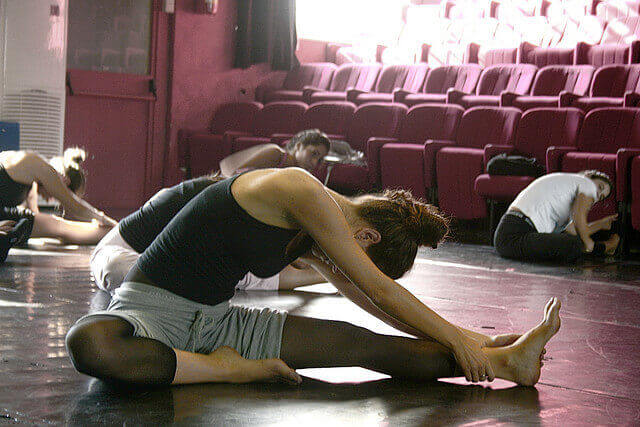
Hold each static stretch 20 to 30 seconds and repeat it two or three times per muscle group • photo: Stefano Salonia • www.flickr.com
Use it: after training, on rest days, or in the evening. It’s the default choice when your goal is long-term range of motion rather than immediate performance.
Skip it: right before a heavy lift, a sprint, or a jump test. Not because it’s dangerous, but because long holds can blunt maximal force for a while.
Example: standing hamstring stretch. Put one heel on a low bench, keep the back flat, hinge from the hips until you feel tension behind the raised leg. Hold 20 to 30 seconds, then switch.
How long? The ACSM position stand recommends flexibility work on 2 to 3 days a week, holding each stretch 10 to 30 seconds and accumulating about 60 seconds per muscle group. That’s two or three rounds of a 20 to 30 second hold.
Dynamic stretching
Dynamic stretching moves a joint through its available range repeatedly and under control. You never park in the end position. You travel there and come straight back.
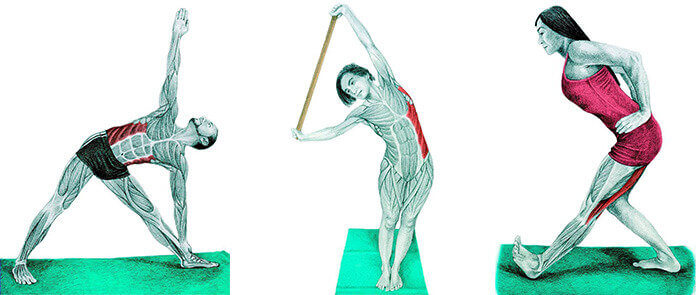
Dynamic drills travel to the edge of your controlled range and come straight back — you never park in the end position • photo: Vicky Timón • Encyclopedia of Pilates Exercises
Use it: as your warm-up, every time. It raises tissue temperature, rehearses the movement you’re about to do, and wakes up the muscles that will do the work.
Skip it: as your only flexibility work. Dynamic drills maintain range well. They’re not the most efficient way to build new range.
Example: walking lunge with an overhead reach. Step into a lunge, reach both arms up and slightly back, then drive through the front foot into the next step. Eight to ten steps per leg.
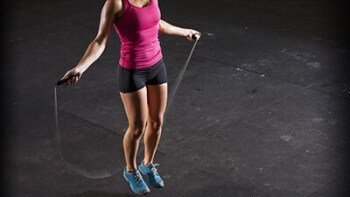
Two or three minutes of jumping rope before your dynamic drills makes them noticeably better. Cold tissue doesn’t lengthen well, and a rope is the cheapest way to fix that.
Active stretching
Active stretching means you hold the position with your own muscles, with nothing else supporting you. The muscle on one side of the joint contracts to stretch the muscle on the other side.
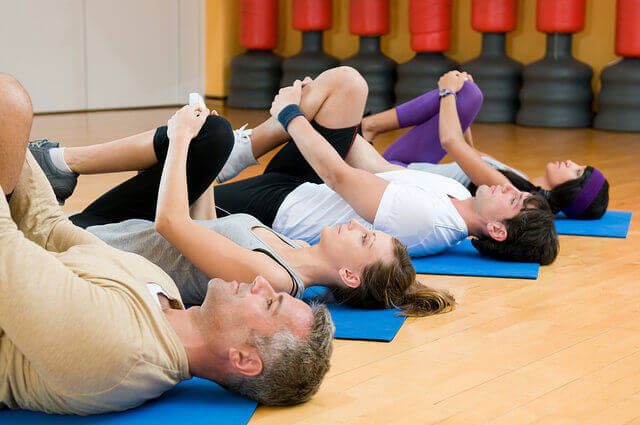
In an active stretch your own muscles hold the position, which is why it feels harder and shallower than a passive one • photo: Bahrain Personal Fitness • www.flickr.com
Use it: when you want usable range rather than range you can only reach with help. Gymnasts and martial artists live here. So does anyone who has flexibility on the floor but loses it the moment they stand up.
Skip it: if you’re chasing a deep, relaxing end-range stretch. Active holds are harder and shallower by design.
Example: lie on your back, lift one straight leg as high as you can using only your hip flexors, hold 2 seconds, lower under control. Eight to ten reps per side. If you catch yourself pulling the leg with your hands, that’s no longer active stretching.
The mechanism has a name: reciprocal inhibition. When the hip flexors fire, the nervous system reduces tension in the hamstrings on the other side of the joint.
Passive stretching
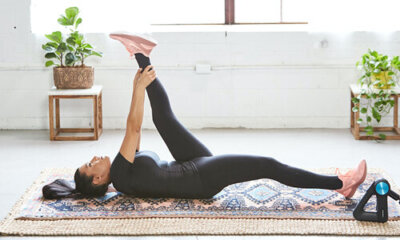
Passive stretching means an outside force holds you in the position. Gravity, a wall, a strap, a suspension trainer, or a partner. Your muscles relax and let it happen.
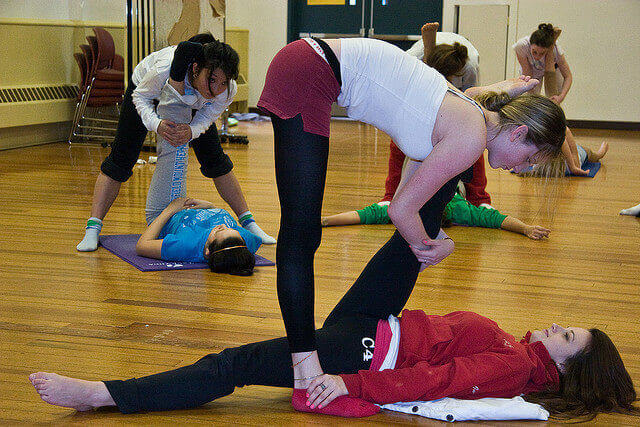
Passive work suits tight hips: let gravity, a strap or a partner hold the position while the muscle relaxes • Photo: Northfield Mount Hermon • www.flickr.com
Use it: after training, and any time you want the deepest, most relaxed version of a position. It’s also the most accessible type for people with poor balance, because you’re not fighting to stay upright.
Skip it: if a partner is pushing you into ranges you can’t control yourself. That’s where passive stretching goes wrong.
Example: doorway chest stretch. Forearm on the door frame at shoulder height, step through with the same-side foot, let your body weight open the chest. Hold 20 to 30 seconds per side. Desk workers should do this daily.
Passive does NOT mean careless. The rule is the same as everywhere else: mild tension, never sharp pain. Sharp, shooting, or burning pain means back off immediately.
PNF stretching, or proprioceptive neuromuscular facilitation
PNF stretching alternates a stretch with a short isometric contraction of the muscle being stretched. The most common version is contract-relax: get into the stretch, push against resistance for a few seconds, relax, then ease deeper.
Use it: when static stretching has stopped producing progress. It’s the technique physical therapists reach for most often, and it works well with a partner or a strap.
Skip it: right before a competition or a max effort, and skip it entirely if you’re brand new to stretching. Contracting hard in a fully lengthened position is not a beginner’s first move.
Example: hamstring contract-relax. Lie on your back, loop a strap around your foot, raise the leg to mild tension. Push your leg down into the strap at roughly a third of your effort for 5 to 6 seconds. Relax fully, then draw the leg a little closer and hold 20 to 30 seconds. Two or three cycles per side.
Worth knowing: PNF reliably increases range of motion, but the evidence that it beats plain static stretching is mixed. Use it because you like it and it fits your session, not because you’ve been told it’s twice as good.
Ballistic stretching, and why most coaches now skip it
Ballistic stretching uses bouncing momentum to push past your end range. Think of someone reaching for their toes and pulsing down repeatedly.
It’s easy to confuse with dynamic stretching, so here’s the line: dynamic movement travels to the edge of your controlled range and returns. Ballistic movement uses momentum to throw you past that edge.
The prevailing recommendation is to leave it out of general fitness programs, and the reasoning is practical rather than dramatic. Bouncing triggers the stretch reflex you’re trying to quiet, it gives you the least control at the moment you have the least protection, and it doesn’t produce bigger range gains than static or PNF work.
The narrow exception: coached athletes in sports that demand fast end-range loading, such as hurdles or gymnastics, sometimes use it late in a warm-up under supervision. That’s a specific tool for a specific job.
Myofascial release with a foam roller
Foam rolling is not stretching, but it belongs in the same conversation because people use it for the same reason: things feel stiff and they want them to feel less stiff.
Instead of lengthening a muscle across a joint, you apply pressure to the tissue and move slowly along it. A 2022 meta-analysis in Sports Medicine found a moderate improvement in range of motion from foam rolling training, with bigger gains from programs longer than four weeks, and no sign that rolling hurts performance.
Use it: before a session when a specific area feels stuck, or after a session as part of winding down. Sixty to ninety seconds per area is plenty.
Skip it: directly over a fresh injury, over a joint, or on the lower back if you have an existing back condition. And don’t grind on one spot until your eyes water. Pressure should be tolerable, not heroic.
One thing to be honest about: rolling doesn’t break up scar tissue or dissolve adhesions. What’s documented is the range of motion effect and the fact that it costs you nothing in performance. That’s enough reason to use it.
Types of stretching compared
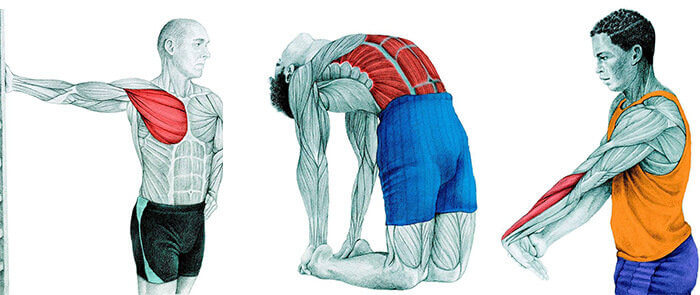
Static and dynamic work are not interchangeable: one builds range, the other prepares you to use it • photo: Vicky Timón • Encyclopedia of Pilates Exercises
| Type | Best used | How long to hold | Not ideal for |
|---|---|---|---|
| Static | After training, rest days, evenings | 20 to 30 seconds, 2 to 3 rounds | Immediately before max strength or sprint work |
| Dynamic | Warm-up, before every session | No hold, 8 to 12 controlled reps | Building brand new range of motion |
| Active | Building usable, controlled range | 2 seconds per rep, 8 to 10 reps | Deep relaxation and wind-down |
| Passive | After training, poor balance, tight hips | 20 to 30 seconds per side | Anyone being pushed by a partner beyond their control |
| PNF | When static work has plateaued | 5 to 6 second contraction, then 20 to 30 second hold | Complete beginners, pre-competition |
| Ballistic | Coached athletes in specific sports only | Not recommended for general fitness | Almost everyone reading this |
| Foam rolling | Before or after, on stiff areas | 60 to 90 seconds per area | Fresh injuries, directly over joints |
Importance of stretching before and after a physical activity

A 20 second hold inside a proper warm-up will not ruin your session; five minutes of deep holds before a max effort might • Photo: rangizzz • www.flickr.com
Dynamic before, static after. That single line answers the question for the overwhelming majority of people, and it’s the rule I’ve coached with since 2011.
Before training you want warm tissue and joints that have rehearsed the movement. Dynamic drills do that. A long, relaxed hold does the opposite of what you need thirty seconds before a heavy set.
But the popular version of this rule went too far. A 2024 systematic review and meta-analysis pooling 83 studies and 2,012 participants found the meaningful drop in maximal strength shows up mainly with holds of 60 seconds or longer per bout. Shorter holds had only a small effect, and no negative effect on general athletic performance was observed.
So a 20 second hamstring stretch inside a proper warm-up won’t ruin your session. Five minutes of deep static holds right before a one-rep max might.
After training is where static and passive work belong. Your tissue is warm, you’re not about to produce force, and the hold costs you nothing.
One expectation to reset: stretching afterwards will not save you from soreness. The Cochrane review by Herbert and colleagues concluded that stretching before, after, or both does not produce clinically important reductions in delayed-onset muscle soreness. Stretch after training because it maintains range and feels good, not because it prevents next-day stiffness.
Why is stretching important

Range of motion is the honest reason to stretch, and getting off the floor without planning it is not a small thing at 50 • Photo: Minoru Nitta • www.flickr.com
This is where a lot of fitness writing overpromises, so here’s the honest version, drawn from the 2025 Delphi consensus statement in which 20 international stretching researchers agreed on what the evidence supports.
What the experts reached consensus on:
- ✅ Both acute and long-term stretching improve range of motion, though other methods can also achieve that.
- ✅ Stretching reduces muscle stiffness, which isn’t always what you want, but often is.
- ❌ Stretch training does not contribute substantially to muscle growth.
- ❌ It is not an all-encompassing injury prevention strategy.
- ❌ It does not improve posture.
- ❌ It does not acutely improve post-exercise recovery.
That’s a shorter list than most articles promise, and it’s the honest one. Range of motion is the reason to stretch, and it’s worth having. Squatting to depth, reaching overhead, and getting off the floor without planning it is not a small thing at 50.
A ready-made warm-up you can use today
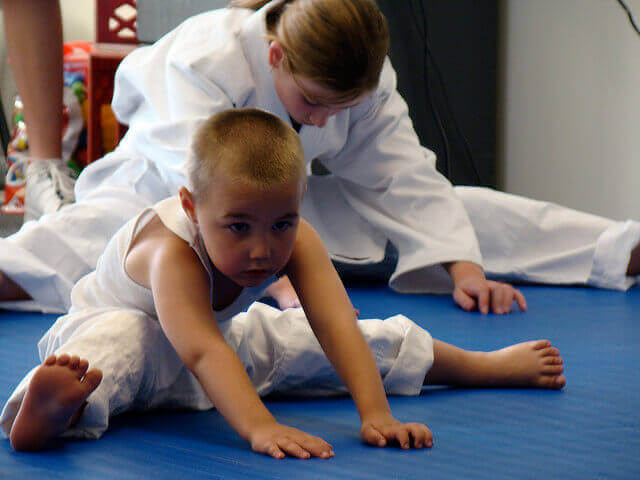
Six minutes of steady movement is enough, and the point is never to park in a position • Photo: Agoge Martial Arts & Fitness • www.flickr.com
Six minutes, no equipment needed. Do this before any session, including a 30-minute full-body workout.
| # | Movement | Dose | What it prepares |
|---|---|---|---|
| 1 | March in place or easy rope skips | 90 seconds | Tissue temperature, heart rate |
| 2 | Arm circles, forward then backward | 10 each direction | Shoulders, upper back |
| 3 | Cat-cow on all fours | 10 cycles | Spinal flexion and extension |
| 4 | Leg swings, front to back | 10 per leg | Hip flexors, hamstrings |
| 5 | Walking lunge with overhead reach | 8 per leg | Hip flexors, quads, thoracic spine |
| 6 | Bodyweight squat to comfortable depth | 12 reps | Ankles, knees, hips |
Two rules: move at a steady pace, and never park in a position. That’s the whole point of a dynamic warm-up.
A ready-made stretching block for after training
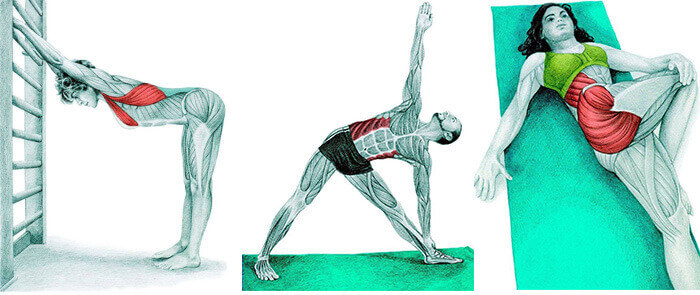
Work through the main muscle groups while you are still warm, not an hour later • Vicky Timón – Encyclopedia of Pilates Exercises
Eight minutes, static and passive holds. Do it while you’re still warm, not an hour later.
| # | Stretch | Hold | Target |
|---|---|---|---|
| 1 | Standing hamstring stretch, heel on a low bench | 25 seconds per leg, 2 rounds | Hamstrings |
| 2 | Half-kneeling hip flexor stretch | 25 seconds per side, 2 rounds | Hip flexors, quads |
| 3 | Doorway chest stretch | 25 seconds per side | Chest, front of shoulder |
| 4 | Seated figure-four glute stretch | 25 seconds per side | Glutes, outer hip |
| 5 | Supine spinal twist, knees to one side | 25 seconds per side | Lower back, obliques |
| 6 | Child’s pose | 45 seconds | Lats, lower back, hips |
Run this two or three times a week and you’ll hit the ACSM volume without thinking about it. If your lower back is the part that complains loudest after a desk day, our lower back routine pairs well with this block.
Common stretching mistakes
- ❌ Stretching cold. Two or three minutes of easy movement first. Every time.
- ❌ Holding your breath. Breath-holding tightens the exact muscles you’re trying to relax. Exhale as you settle deeper.
- ❌ Chasing pain. Mild tension is the target. Sharp or burning means you’ve gone past it.
- ❌ Bouncing to get further. That’s ballistic stretching by accident, and it triggers the stretch reflex.
- ❌ Long static holds right before max effort. Keep pre-session holds short and save the long ones for afterward.
- ❌ Stretching only what already feels loose. Most people stretch their hamstrings and ignore their hip flexors and chest, which are usually the actual problem.
- ❌ One long session a month. Three short sessions a week beats one heroic hour. Range of motion responds to frequency.
When not to stretch
Stretching is low risk for most healthy adults. There are still situations where it’s the wrong call.
- Acute muscle injury. In the days after a strain or tear, pulling on damaged tissue is not rehab. Get it assessed and follow a clinician’s plan.
- Hypermobility. If your joints already move further than average, more end-range stretching is usually the wrong lever. Physical therapy for hypermobility spectrum disorders leans toward stability, motor control, and strength instead.
- Recent surgery. Any joint replacement, ligament repair, or abdominal surgery comes with a protocol. It wins over anything you read online, including this article.
- Osteoporosis or known bone density issues. Some spinal flexion and rotation positions may not be appropriate. Ask your doctor which ones apply to you.
- Sharp, shooting, or numbing sensations. Tingling or numbness during a stretch is a nerve signal, not a flexibility signal. Stop.
Stretching manages stiffness and builds range of motion. It does NOT treat injuries, cure back pain, or replace medical care. If something hurts consistently, see a professional rather than stretching harder.
TRX training and stretching
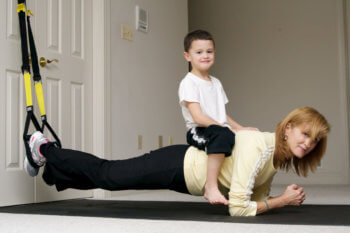
A suspension trainer turns hard-to-hold stretches into supported ones. That’s the whole argument, and it’s a practical one rather than a marketing one.
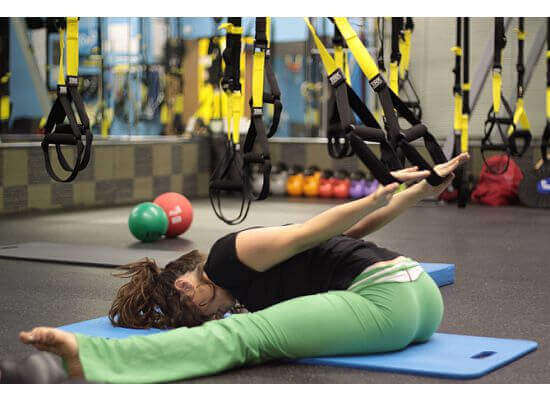
Holding the straps removes the balance demand, so the muscle you are stretching can actually relax • photo: Donavan Brown • www.flickr.com
Two things change when you hold the straps. You stop spending attention on balance, so the muscle you’re stretching can actually relax. And you control depth with your feet: step toward the anchor and the stretch eases, step away and it deepens.
That matters most for people over 50, anyone with balance issues, and anyone who finds getting down to the floor the hardest part of the routine. If you’re new to the tool, start with what a TRX Suspension Trainer actually is, and check the anchoring options before you hang anything.
Four positions worth learning, using official TRX exercise names:
- TRX Low Back Stretch (Standing Lean-Away). Face the anchor point, grip both handles with arms extended, walk your feet forward until the straps are taut. Sit your hips back, round your upper and lower back, let your head drop between your arms. Hold 20 to 30 seconds, 2 to 3 rounds. Step your feet closer to the anchor to make it easier, farther to go deeper.
- TRX Hamstring Stretch. Face the anchor, hold both handles at hip height with arms extended. Extend one leg in front of you, heel down, toes up. Hinge at the hips with a flat back and a lifted chest. Hold 20 to 30 seconds per leg, twice per side.
- TRX Chest Stretch. Set the straps at mid-length. Face away from the anchor in an offset stance, stay tall, establish your plank, then lean your sternum forward to open the chest. Settle into the back heel to lengthen the whole front of the body, hip flexors included. Hold 20 to 30 seconds per side.
- TRX Hip Drop Stretch. Stand side-on to the anchor and grip both handles with the hand nearest to it. Feet together, free arm overhead for balance. Push your hips away from the anchor and let the straps take your weight as your torso makes a C-curve. Hold 15 to 20 seconds per side, twice.
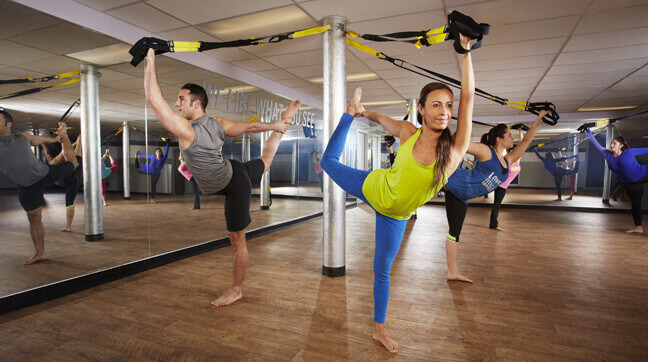
Set the depth with your feet: step toward the anchor to ease the stretch, away from it to go deeper • photo: Youbeauty.com
Use the first three as a cool-down after leg work, and the TRX Cossack Stretch or a wide-stance TRX Hip Hinge earlier as dynamic warm-up options.
Get 15% off any TRX
Disclosure: This post contains affiliate links. If you buy through them, I may earn a commission at no extra cost to you — and you get 15% off with my code TRX15LUKAS. I only recommend gear I actually use.
If assisted stretching is why you’re considering a suspension trainer, you don’t need the most expensive model. Any genuine TRX Suspension Trainer holds these four positions well. A solid anchor point matters more.
Use code TRX15LUKAS for 15% off any TRX product: suspension trainers, training tools, apparel, education courses, and apps. It’s not a limited-time gimmick, it’s my ambassador code and it works year-round. 🎁
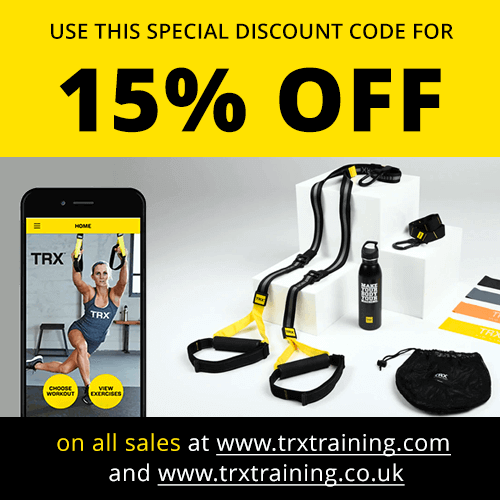
Try it here: how to apply the TRX discount code. If you’re still deciding between models, our TRX comparison guide walks through which one fits which situation.
Frequently asked questions about types of stretching
Conclusion
Six types, one rule you’ll actually remember: move before you train, hold after you train.
Static and passive work builds range. Dynamic work prepares you to use it. Active work makes that range yours to control. PNF is for when progress stalls, foam rolling is a useful companion, and ballistic stretching is the one you can safely leave alone.
Stretch to the point of tension, never into pain. Breathe out as you settle. Three short sessions a week beat one long one, and the two routines above take fourteen minutes between them.
Try the eight-minute block after your next session. 💪