


🎁 How to apply the TRX Training Discount Code

Jumping rope trains your body from the ankles up. Every skip pushes your heart rate into the vigorous zone within about a minute, loads your calves, shins, feet and quads with hundreds of small rebounds, and makes your deep core and forearms work isometrically to hold you steady. It builds cardiovascular fitness, ankle stiffness, foot strength and coordination faster than almost any tool you can fit in a jacket pocket. What it does not do is build strength in your back, chest or arms — and it is not automatically easier on your joints than running.
That is the short answer. Below it is the part that never fits in a search result: every muscle that works and how hard, the real calorie comparison against running with the source attached, a four-week plan, and an honest list of who should not be jumping at all.
Who Jumping Rope Is For and Who It Is Not
I have used a rope with clients since 2011, and it sorts people fast.
It fits you if you want conditioning in under 15 minutes, travel often, train at home, play a sport that needs quick feet, or already run and want a second cardio option.
It does not fit you right now if you have ankle, Achilles or knee pain, are coming back from a lower-limb injury, are pregnant or recently postpartum, or carry enough body weight that hundreds of landings would be your first real impact work in years. None of those are permanent bans — there is a section on each below.
💡 If you have not done impact training in the last six months, do NOT start with a 10-minute session. Impact tolerance builds far slower than cardio fitness does, and that mismatch is how people end up with shin splints in week two.
- Every skip is a full plantar flexion cycle: your gastrocnemius and soleus push you off the floor, then absorb the landing eccentrically. At 120 skips a minute, that is 120 loading cycles through one muscle group.
- Between skips, your tibialis anterior lifts your toes so the rope clears. It is small and it never rests — that is the burning line down your shin in week one.
- Your Achilles tendon and plantar fascia act as springs, storing energy on landing and returning it on push-off. Loaded gradually, that is why experienced jumpers look effortless. Loaded too fast, it is why tendons complain.
- Your quadriceps barely shorten at all — they work almost entirely eccentrically, controlling a small knee bend on each landing.
Why it works: jumping rope is a high-frequency, low-amplitude plyometric. You are not training range of motion — you are training how fast your ankle, foot and calf absorb and return force.
What Muscles Does Jump Rope Work?
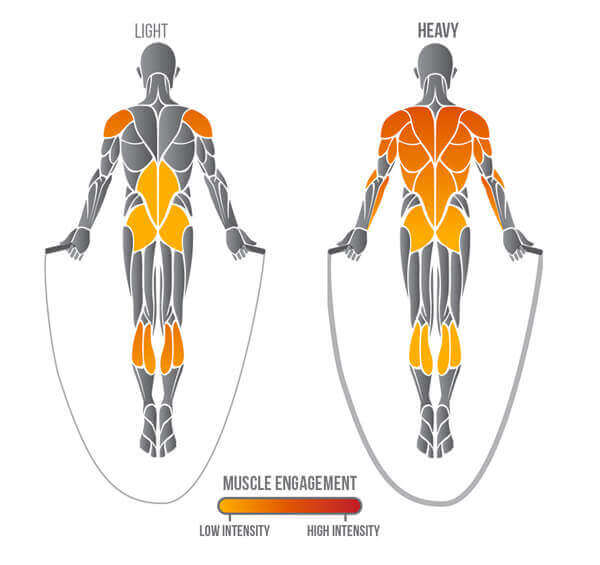
Calves, shins and feet do most of the work, while your core and forearms hold on isometrically.
This is what people actually type, and the usual answer is a useless “it works your whole body.” Here is what each group really does on every skip.
| Muscle group | What it does on every skip | How hard it works |
|---|---|---|
| Calves (gastrocnemius, soleus) | Push you off the floor and absorb the landing through the ankle | Hardest working group by a wide margin. First place you get sore. |
| Tibialis anterior (front of shin) | Lifts your toes between skips so the rope passes underneath | Constant, with no rest phase. This is the shin burn. |
| Foot arch muscles and plantar fascia | Store and return energy like a spring on each contact | High, and almost always ignored elsewhere in training |
| Quadriceps | Control the small knee bend on landing | Moderate, and almost entirely eccentric |
| Hamstrings and glutes | Extend the hip on push-off, decelerate it on landing | Moderate. Assisting, not leading. |
| Deep core (transverse abdominis, obliques) | Holds your ribcage stacked over your pelvis so you do not fold at the waist | Isometric, low load, long duration |
| Erector spinae | Keeps your spine tall under repeated small impacts | Isometric endurance |
| Forearms and wrists | Turn the rope. All of the turning happens here, not at the shoulder. | High endurance, very low force |
| Shoulders and upper back | Hold your elbows pinned near your ribs for the whole set | Isometric holding only. This is not shoulder training. |
What it barely touches: your chest, lats, biceps and triceps do close to nothing. If explosive legs are the goal, the rope builds the reactive quality but not the strength underneath it — pair it with exercises that load your legs through a full range.
Does Jumping Rope Burn More Calories Than Running?
You will read everywhere that it does. The honest answer: it depends entirely on how fast the run is. The 2024 Adult Compendium of Physical Activities gives every activity a MET value, where one MET is roughly what you burn sitting still.
| Activity | Compendium code | METs |
|---|---|---|
| Rope skipping, general | 02068 | 11.0 |
| Jogging, self-selected pace | 12020 | 7.5 |
| Running, 12 min/mile (5 mph) | 12030 | 8.5 |
| Running, 10 min/mile (6 mph) | 12050 | 9.3 |
| Running, 8.5 min/mile (7 mph) | 12070 | 11.0 |
| Running, 7.5 min/mile (8 mph) | 12090 | 12.0 |
| Vigorous intervals (burpees, squat jumps, Tabata) | 02214 | 11.0 |

Rope skipping is rated at 11.0 METs, which beats jogging but not an eight-minute mile.
Yes, against jogging. Steady jogging sits at 7.5 METs, rope work at 11.0. Minute for minute the rope wins clearly.
No, against a fast run. An 8-minute mile beats it. The blanket claim that jumping rope burns more calories than running is simply not true.
The rope wins on access, not on rate. Almost nobody runs 7.5-minute miles for 20 minutes. Almost anybody can hit 11 METs in their living room in under a minute, with no travel and no weather.
Calories per minute ≈ METs × 3.5 × your body weight in kg ÷ 200
For a 165 lb (75 kg) person that is roughly 14 calories a minute on the rope against roughly 10 jogging. Treat both as estimates — your real number moves with fitness and skill.
What Does Jumping Rope Do for Your Heart and Lungs?
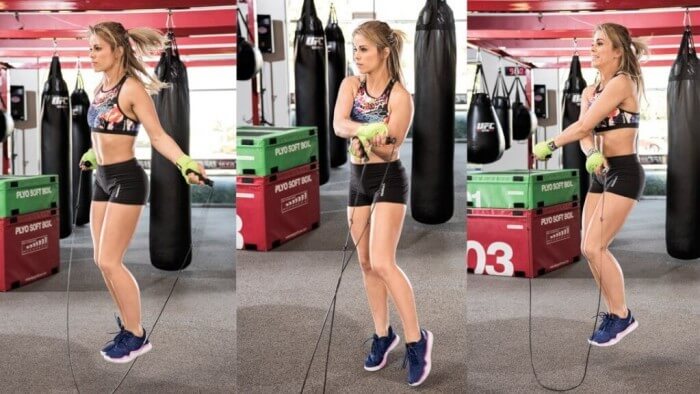
You reach a useful training heart rate in about 60 seconds, with no ramp-up and no equipment.
At 11 METs, jumping rope is vigorous-intensity by any standard definition, and it gets there fast because your legs, arms and core all draw blood at once. In practice you reach a useful training heart rate in about 60 seconds, with no ramp-up and no equipment. It also trains something running does not: coordination under fatigue. Your arms turn at one rhythm while your legs bounce at another, and when you tire, the timing fails before the muscle does.
How to Jump Rope With Good Technique

Keep your elbows near your ribs and turn the rope with your wrists, not your shoulders.
Rope length first. Stand on the middle of the rope with one foot and pull the handles up your sides. For a beginner the handle tops should reach about your armpits; shorten toward chest height as you improve. A rope that is too long makes you jump higher than necessary, and that is where most beginner soreness starts.
- Elbows close to your ribs, hands just in front of your hip bones. Arms out wide means the rope is too short or you are turning from the shoulder.
- Turn with your wrists. Small circles. Your upper arms should barely move.
- Jump about an inch (2–3 cm) — just enough for the rope to pass. If you can hear yourself landing from another room, you are jumping too high.
- Land on the balls of your feet, then let your heels lower without slamming. Never land flat or on your heels.
- Keep your knees soft but do not squat. The bend is small and it happens on landing, not on push-off.
- Look forward, not down. Watching the rope tips your head and rounds your upper back.
Warm up your ankles and calves first. A proper dynamic warm-up before and static stretching after will do more for your shins than any shoe will.
The 6 Mistakes That Make Skipping Hurt
- Jumping too high. Every extra inch is extra landing force multiplied by hundreds of reps.
- Double bouncing. An extra small hop between turns. It feels safer, doubles your impact volume, and locks you out of any real speed.
- Turning from the shoulders. Your arms fatigue, your rhythm dies, and you start flailing.
- Landing flat-footed. Sends impact straight through your knees and hips instead of letting your ankle and calf absorb it.
- Too much, too soon. Your lungs adapt in days; your Achilles, shins and plantar fascia adapt in weeks.
- Concrete plus worn-out shoes. Jump on wood, rubber or a mat, in cross-trainers with a stable forefoot — not soft running shoes and not barefoot.
❌ Do NOT use asphalt or bare concrete as your regular surface. It is the fastest route to shin splints, and shin splints cost more weeks than a mat costs dollars.
How Long and How Often Should You Jump Rope?

Work in intervals rather than continuously — technique is the first thing you lose when you are gassed.
Frequency: three sessions a week to start, four once you can jump a full minute without breaking. Leave a day between sessions in the first month so your tendons recover.
Duration: count actual jumping time, not session time. A beginner accumulating 3 to 5 minutes of real jumping is training appropriately.
Format: intervals, always. Continuous jumping teaches you to survive rather than to jump well, and technique is the first thing you lose when you are gassed.
A 4-Week Beginner Jump Rope Plan
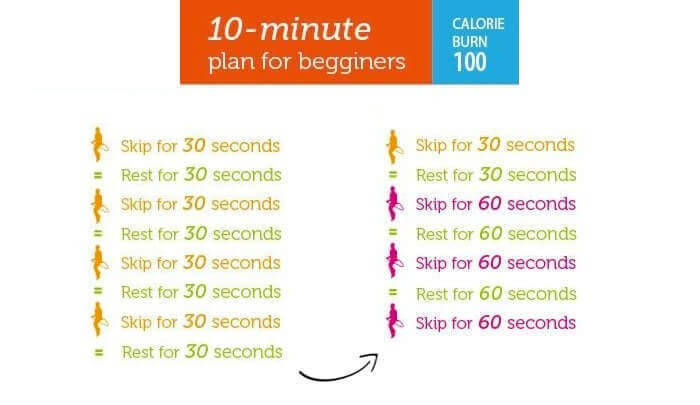
Count actual jumping time, not session time — three to five minutes is a full beginner session.
Open every session with two minutes of ankle circles, calf raises and easy marching. Close it with calf and hip flexor stretching.
| Week | Sessions | Jump | Rest | Rounds | Total jumping |
|---|---|---|---|---|---|
| 1 | 3 per week | 20 sec | 40 sec | 8 | 2 min 40 sec |
| 2 | 3 per week | 30 sec | 30 sec | 10 | 5 min |
| 3 | 3 to 4 per week | 45 sec | 30 sec | 10 | 7 min 30 sec |
| 4 | 3 to 4 per week | 60 sec | 30 sec | 10 | 10 min |
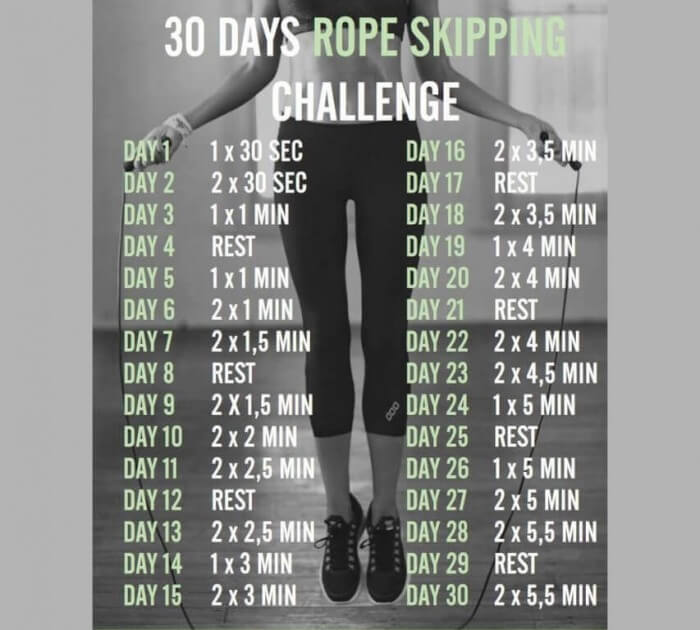
If your shins or Achilles ache the next morning, repeat the previous week instead of progressing.
The rule that overrides the table: if your shins or Achilles are sore the next morning, repeat the previous week instead of progressing. Nobody ever lost fitness by taking five weeks to reach ten minutes.
After week four, add speed inside the same 60-second blocks, or keep the rope as a finisher with strength work in front of it — this 30-minute whole-body routine slots in ahead of it well.
Who Should Not Jump Rope
Skipping is impact training, and that makes the rope genuinely wrong for some people right now. Here is the honest list, with what to do instead.
- Current ankle, Achilles or foot pain. Every skip loads exactly the tissue that hurts. Get it assessed; cycle, row or swim meanwhile.
- Knee pain, especially around or under the kneecap. The forefoot landing and tiny vertical displacement make rope work mechanically different from running, and plenty of people tolerate it better. Plenty do not. Test with 10 seconds, not 10 minutes.
- A history of shin splints. You can jump, but treat week one of the plan as your ceiling for a month, and only on a mat.
- Flat feet or heavy overpronation. Not a ban, but you need shoes with real forefoot stability rather than soft cushioning, plus shorter sets. If your arch aches afterward, see a podiatrist before adding volume.
- A higher body weight. Landing force scales with mass. Start with no jumping at all: hold both handles in one hand, turn the rope at your side, and march in place. Build four weeks of that on a mat, then add the jump.
- Pregnancy or the early postpartum months. Repeated jumping raises intra-abdominal pressure. Clear it with your provider, not with an article.
- Leaking urine when you jump, cough or sneeze. Common, not something to train through, and treatable. A pelvic floor physical therapist is the right first stop.
- Osteoporosis, a recent fracture, or an uncontrolled heart condition. Talk to your doctor before adding vigorous impact work.
- Ongoing low back pain. Impact travels up the chain. Build tolerance with targeted lower back work first, then reintroduce the rope in short sets.
💡 This is general training information, not medical advice. Soreness that shows up the next morning and eases with walking is usually load. Pain that sharpens as you go is not — stop and get it looked at.
What Jumping Rope Will Never Train for You
Look back at the muscle table and the gap is obvious. The rope is excellent from the hips down and does almost nothing above them.
There is no pulling in jumping rope. None. Your lats, rhomboids and mid-traps never contract against resistance. There is also no loaded pressing, no hip hinge through a real range, and your core works one way only — isometrically, resisting collapse. It never has to resist rotation, and rotation is the pattern you use most in daily life.
You can close all four gaps with anything: dumbbells, a pull-up bar, a gym membership. I use a TRX Suspension Trainer for the same reason I use a rope — it lives in a bag and works anywhere 💪
- TRX Low Row — the pull the rope never gives you
- TRX Chest Press — pressing against your own body weight
- TRX Single Leg RDL — the hip hinge, plus single-leg balance that transfers back into landing
- TRX Power Pull — rotation, the pattern jumping never touches
- TRX Plank — suspended plank variations produced significantly higher abdominal activation than the same plank on the floor in the Journal of Strength and Conditioning Research
To be clear: you do not need a suspension trainer to benefit from jumping rope. This is only about what a rope-only program leaves on the table. To see how the two fit into one week, start with the full library of suspension workouts.
Gear: What Rope to Buy and How to Get 15% Off TRX
Buy adjustable. Length decides whether your first month is fun or painful. A PVC speed rope covers everything a beginner needs. Skip weighted ropes until you can hold two clean minutes — they magnify every technique flaw you still have.
Disclosure: This post contains affiliate links. If you buy through them, I may earn a commission at no extra cost to you — and you get 15% off with my code TRX15LUKAS. I only recommend gear I actually use.
🎁 For the strength half of the pairing, my code TRX15LUKAS takes 15% off anything TRX sells — suspension trainers, jump ropes and speed ropes, training tools, apparel, education and apps. You enter it in the cart and it works on bundles too.

- How to apply the TRX15LUKAS discount code — check the price and see exactly where the code goes
- Which TRX model to buy — an honest comparison, including who should not pay for the PRO
- Where to anchor it at home — door, ceiling, beam or outdoors
FAQ: Jumping Rope Questions People Actually Ask
The Bottom Line
Jumping rope does more for your ankles, calves, feet, heart and coordination per minute than almost anything you can carry in a pocket. It does nothing for your back, chest or arms, and it does not beat running at every speed. Know both halves of that and it becomes what it should be: ten hard minutes of conditioning you can do anywhere, alongside strength work rather than instead of it. Try week one of the plan above.